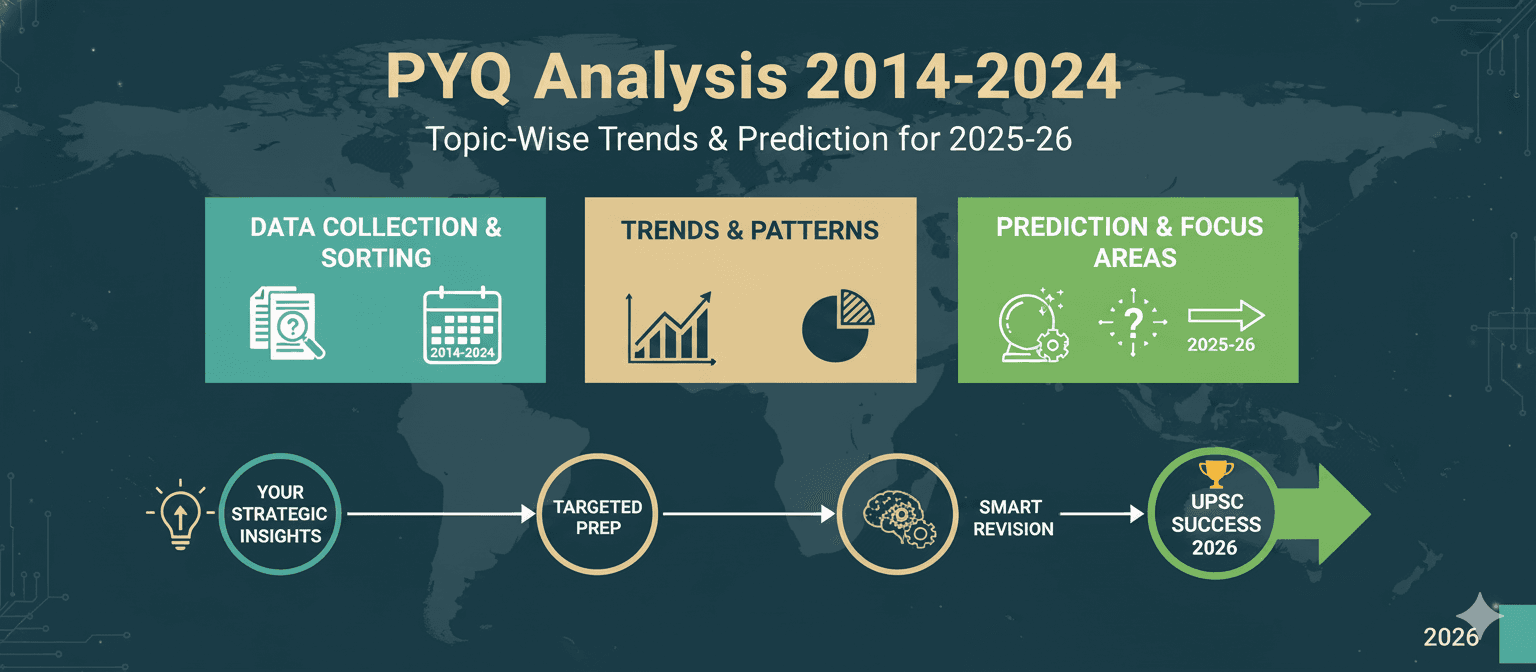
PYQ Analysis 2014-2024: Topic-Wise Trends & Prediction for 2025-26
5 min read
Dec 19, 2025
Introduction
What separates toppers from average aspirants isn't just hard work—it's strategic preparation backed by data. A decade of UPSC Previous Year Questions (2014-2024) reveals unmistakable patterns that can transform your preparation from guesswork to precision targeting.
This comprehensive analysis decodes exactly what UPSC has prioritized over the last 11 years, which topics are gaining momentum, what's fading into the background, and most importantly—what you should focus on for 2025-26.
Subject-Wise Weightage Trends (2021-2025)
The following table captures the question distribution across major subjects in recent years:

Key Trends Emerging from the Decade
Rising Subjects (Increased Weightage)
Geography has shown the most dramatic rise—jumping from 12 questions in 2021 to 23 in 2025. Physical geography concepts, Indian agriculture, natural resources, and climate-related topics are increasingly dominating the paper. This reflects UPSC's growing emphasis on environmental awareness and spatial understanding.
Environment & Ecology maintains consistent importance (10-15 questions annually). With global climate discussions intensifying, expect continued focus on biodiversity, conservation policies, international environmental agreements, and sustainable development.
Stable Subjects (Consistent Weightage)
Indian Polity remains the backbone of Prelims with 12-14 questions yearly. Constitutional provisions, amendments, landmark judgments, and governance mechanisms continue to be tested. The 2023 paper notably included questions on the Nari Shakti Bill, signaling UPSC's attention to recent legislative developments.
Economy fluctuates between 14-18 questions. Recent papers emphasize conceptual clarity over mere factual recall—questions on banking operations, monetary policy instruments, and application-based scenarios are becoming standard.
Science & Technology holds steady at 13-14 questions, with increasing integration of current affairs (space missions, biotechnology developments, digital initiatives).
Declining Areas
Static History questions, particularly Ancient and Medieval History, have shown reduced direct recall-based questions. However, questions now integrate historical facts with analytical interpretation. Modern History remains relevant but is increasingly connected with current affairs themes.
Difficulty Evolution (2014-2024)
The UPSC Prelims has undergone a significant transformation in question complexity:
2014-2018: Questions were relatively straightforward, with clear elimination options. Standard textbook knowledge was sufficient for most questions.
2019-2022: Introduction of statement-based and match-the-following formats increased difficulty. Current affairs integration became deeper, requiring understanding of connections rather than isolated facts.
2023-2024: Marked shift toward analytical and application-based questions. The 2023 paper introduced new MCQ formats that reduced the effectiveness of elimination techniques. Pair-based questions became more prevalent.
2025: The paper returned to a more traditional format with approximately 15 match-the-following questions, signaling a potential stabilization of the pattern.
Predictions for 2025-26
Based on decade-long trend analysis, here's what aspirants should prioritize:
High-Priority Areas
Geography & Environment (Combined 30-35 questions expected): Physical geography fundamentals, climate change and sustainability, biodiversity hotspots, agricultural geography, and map-based interpretation. This combined domain is non-negotiable for serious aspirants.
Polity (15-18 questions expected): Focus on constitutional amendments post-2019, governance reforms, judicial pronouncements, and recent legislative bills. Centre-State relations and federalism concepts will remain important.
Economy (14-17 questions expected): Expect calculation-based questions (a new trend from 2025), banking sector reforms, digital economy initiatives, and budget-related concepts. Understanding of RBI policies and government schemes is essential.
Medium-Priority Areas
History & Art and Culture (12-16 questions expected): Ancient India and Modern India will carry more weight than Medieval History. Art and Culture questions increasingly link to UNESCO heritage sites and cultural preservation initiatives.
Science & Technology (12-15 questions expected): Space missions (ISRO achievements), biotechnology applications, emerging technologies (AI, quantum computing basics), and government S&T initiatives.
Preparation Shifts Required
Current Affairs Window: UPSC has been asking questions from current affairs topics older than one year. Prepare with a 1.5-2 year window rather than just the immediate 6-12 months.
Conceptual Integration: Questions increasingly require connecting dots across subjects. A climate change question might integrate geography, environment, economy, and international relations.
Analytical MCQ Skills: Develop the ability to handle tricky elimination-resistant questions through regular mock test practice.
Strategic Preparation Prioritization
Based on this analysis, allocate your preparation time as follows:

Conclusion
The UPSC Prelims has evolved from a knowledge-testing examination to an analytical aptitude assessment. Success in 2025-26 demands understanding patterns, not just memorizing facts. Geography and Environment's rising prominence, the consistent importance of Polity and Economy, and the declining weightage of rote-based History questions all point toward an examination that rewards conceptual clarity over information overload.
Your preparation strategy should reflect these trends. Focus on high-yield subjects, develop analytical question-solving skills, and maintain a broader current affairs window. The data is clear—those who adapt to these patterns will have a decisive advantage.
Written By

Suggested Posts

The Accuracy Trap: Why the Shorter GRE Punishes Old Study Habits — and How to Rewire Your Prep Strategy
Mar 31, 2026

GRE Score Validity & Sending Scores 2026: When Scores Expire, ScoreSelect Strategy & Smart Reporting
Mar 18, 2026
GRE for Indian Students 2026: Complete Guide to Eligibility, Fees, Preparation Tips & Common Mistakes
Mar 18, 2026

Designing Your GRE Study Plan: From Target Scores to Tracking Progress
Mar 13, 2026
GRE Syllabus 2026: All Topics & Question Types Demystified
Mar 13, 2026

GRE Costs & Policies: Exam Fees, Retakes & Score Reporting Explained
Mar 13, 2026

GRE Quantitative Reasoning 2026: The Complete Strategy Guide
Mar 13, 2026

GRE Analytical Writing 2026: Complete Guide, Templates & Scoring
Mar 13, 2026

GRE Scores for Top Universities 2026
Mar 13, 2026

GRE At Home vs Test Center 2026: Complete Comparison + Which One Is Right for You (India Guide)
Mar 13, 2026