UPSC Optional Subject Selection 2026: Scoring Analysis Guide
5 min read
Dec 12, 2025
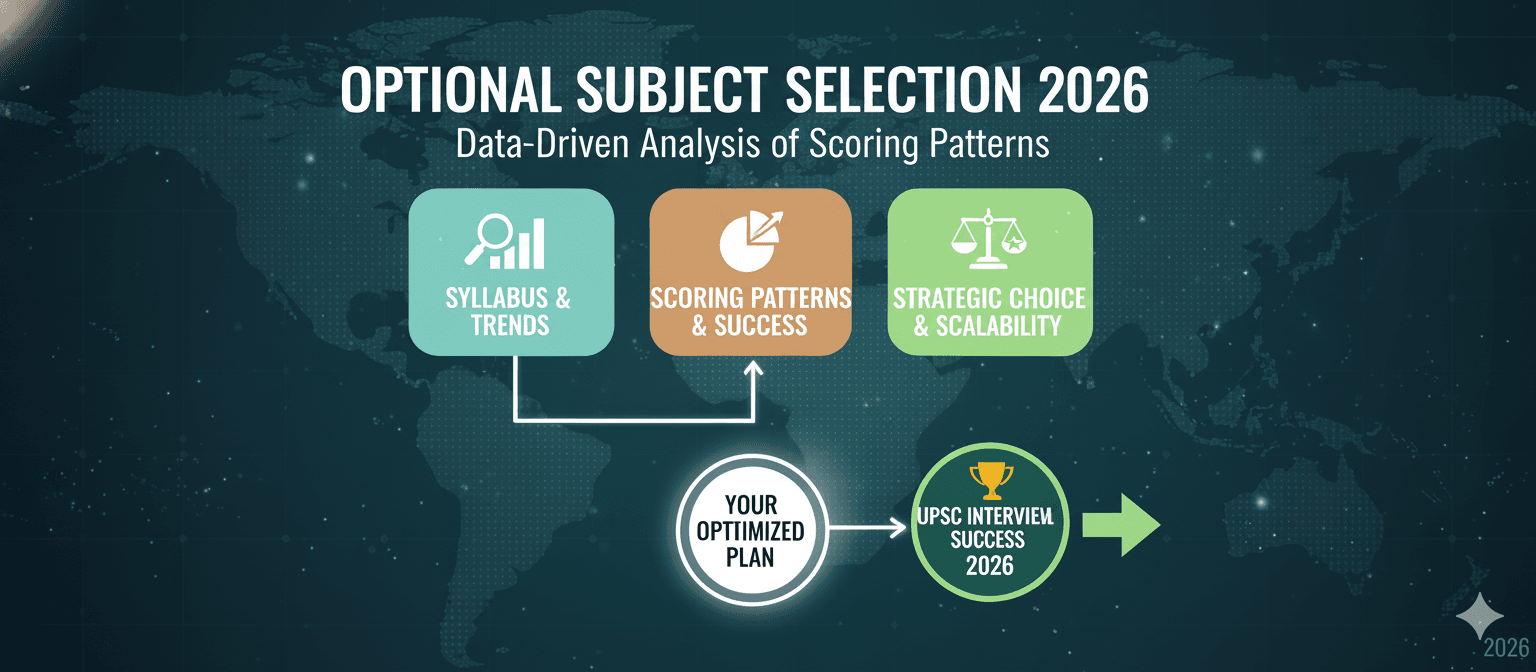
Your optional subject isn't just another paper—it's 500 marks that can make or break your final rank. With nearly 29% of your UPSC Mains score riding on this single choice, selecting the right optional requires more than gut feeling.
This analysis examines actual scoring data, success rates from UPSC Annual Reports, and topper patterns to help you make an evidence-based decision for CSE 2026.
The Five-Factor Framework for Optional Selection
Before diving into data, understand that no subject is universally "best." The optimal choice emerges from evaluating five critical factors against your profile.
Factor 1: Success Rate Analysis
Success rate measures how many candidates with a particular optional eventually get recommended. Based on UPSC's 72nd Annual Report data, subjects with 100+ candidates showed these trends:
Law recorded the highest success rate at 13.8%, followed by Economics at 13.1% and Commerce & Accountancy at 12.9%. Notably, these are technical subjects—challenging the myth that only "easy" optionals score well.
Among popular humanities optionals, Anthropology, Sociology, and PSIR consistently show success rates between 8-12%, making them reliable choices for aspirants without technical backgrounds.
Factor 2: GS Syllabus Overlap
Strategic overlap reduces your total preparation burden. Here's how major optionals align with General Studies:
High Overlap (40-60% synergy):
Geography connects with GS-I (physical geography) and GS-III (environment, disaster management). Political Science & IR directly feeds GS-II (polity, governance, international relations) and Essay. Sociology shares significant content with GS-I (Indian society) and GS-IV (ethics case studies). Public Administration mirrors GS-II governance and administrative reforms topics.
Moderate Overlap (20-40% synergy):
History benefits GS-I (modern India, culture) and Prelims substantially. Philosophy's ethics components strengthen GS-IV preparation. Economics directly supports GS-III macro-economic concepts.
Minimal Overlap:
Mathematics, Physics, Engineering subjects, and Literature papers operate largely independent of GS syllabus.
Factor 3: Resource Availability
Your preparation quality depends heavily on accessible study material and guidance. Subjects fall into three tiers:
Tier 1 (Abundant Resources):
Geography, PSIR, Sociology, Public Administration, History—multiple standard books, established coaching, extensive online content, and active peer communities.
Tier 2 (Adequate Resources):
Anthropology, Philosophy, Economics, Law—sufficient standard texts and coaching options, though less abundant than Tier 1.
Tier 3 (Limited Resources):
Regional literature papers, technical subjects like Agriculture, Medical Science, Engineering branches—fewer standardized materials, often requiring self-study or specialized mentors.
Factor 4: Coaching Necessity
Not all optionals require coaching equally:
Self-Study Friendly:
Philosophy and Anthropology have concise syllabi manageable through standard texts. Many toppers have cracked these without formal coaching.
Coaching Recommended:
PSIR, Sociology, and Geography benefit significantly from structured guidance due to answer-writing patterns and current affairs integration requirements.
Coaching Essential:
Technical subjects like Mathematics and Engineering optionals typically need expert guidance for problem-solving approaches and scoring strategies.
Factor 5: Background-Subject Matching
Your academic foundation matters, but not absolutely. Here's what data reveals:
Strong Correlation:
Engineering graduates perform well in Mathematics, Physics, and technical optionals. Law graduates have natural advantages in Law optional. Economics graduates find Economics optional manageable.
Moderate Correlation:
Science graduates increasingly choose Sociology and Anthropology successfully—their analytical training compensates for lack of subject background.
Weak Correlation:
UPSC 2024 topper Shakti Dubey chose PSIR despite a Biochemistry background. 2023 topper Aditya Srivastava cleared with Electrical Engineering optional without a traditional engineering job background.
What Topper Data Actually Reveals
Analyzing AIR-1 holders from 2015-2024 shows remarkable diversity:
PSIR produced three rank-1 holders (Tina Dabi 2016, Ishita Kishore 2022, Shakti Dubey 2024). Anthropology delivered two toppers (Nandini KR 2016, Anudeep Durishetty 2017). History, Mathematics, and Electrical Engineering each produced one topper in recent years.
The critical insight? No single optional dominates consistently. What matters is preparation depth, not subject choice alone.
The Decision Matrix: Finding Your Optimal Match
Use this framework to shortlist 2-3 subjects:
Step 1:
List subjects you genuinely find interesting. Preparation spans 3-4 months minimum—sustained motivation requires genuine curiosity.
Step 2:
Check your graduation subject. If it matches a UPSC optional, it belongs on your shortlist unless you actively dislike it.
Step 3:
Evaluate overlap benefit. If your GS preparation is weak, high-overlap subjects like Geography, PSIR, or Sociology provide dual benefits.
Step 4:
Assess resource accessibility in your location. Can you access coaching, test series, and peer groups for your chosen subject?
Step 5:
Attempt 3-5 Previous Year Questions from each shortlisted subject. Your comfort level with question patterns reveals more than syllabus analysis.
Common Selection Mistakes to Avoid
Chasing trends blindly:
A subject's popularity doesn't guarantee your success. Anthropology's high success rate means nothing if you find tribal studies uninteresting.
Ignoring preparation time:
Geography and History have vast syllabi requiring 5-6 months. Philosophy and Anthropology can be covered in 3-4 months. Match your timeline.
Overvaluing overlap:
High GS overlap helps only if you prepare the overlapping portions seriously. Superficial coverage defeats the purpose.
Switching optionals late:
Changing your optional after preliminary preparation wastes months. Invest 2-3 weeks in exploration before committing.
Final Recommendation
For CSE 2026 aspirants, here's a practical approach:
If you have no strong preference, start with Sociology, Anthropology, or Philosophy—their concise syllabi allow faster completion, leaving more time for GS preparation.
If you have relevant academic background in Law, Economics, or Engineering subjects, leverage that foundation despite lower popularity.
If you prioritize GS integration, choose Geography, PSIR, or Public Administration for maximum syllabus synergy.
Remember: 700-1000 focused hours with any optional can yield 280+ marks. Your commitment matters more than your subject choice.
Written By

Suggested Posts
The Accuracy Trap: Why the Shorter GRE Punishes Old Study Habits — and How to Rewire Your Prep Strategy
Mar 31, 2026
GRE Score Validity & Sending Scores 2026: When Scores Expire, ScoreSelect Strategy & Smart Reporting
Mar 18, 2026
GRE for Indian Students 2026: Complete Guide to Eligibility, Fees, Preparation Tips & Common Mistakes
Mar 18, 2026
Designing Your GRE Study Plan: From Target Scores to Tracking Progress
Mar 13, 2026
GRE Syllabus 2026: All Topics & Question Types Demystified
Mar 13, 2026

GRE Costs & Policies: Exam Fees, Retakes & Score Reporting Explained
Mar 13, 2026
GRE Quantitative Reasoning 2026: The Complete Strategy Guide
Mar 13, 2026
GRE Analytical Writing 2026: Complete Guide, Templates & Scoring
Mar 13, 2026
GRE Scores for Top Universities 2026
Mar 13, 2026

GRE At Home vs Test Center 2026: Complete Comparison + Which One Is Right for You (India Guide)
Mar 13, 2026