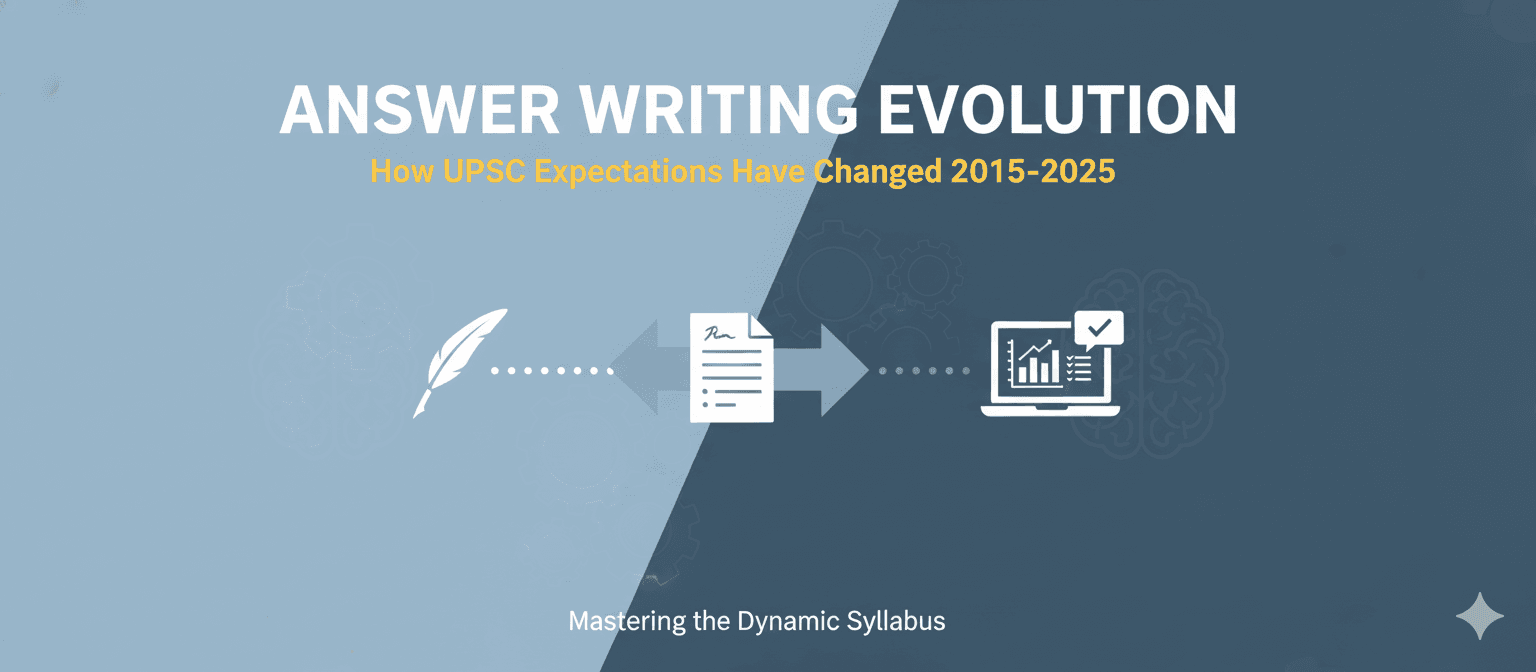
Answer Writing Evolution: How UPSC Expectations Have Changed 2015-2025
5 min read
Dec 06, 2025
Introduction
The decade between 2015 and 2025 has witnessed a fundamental transformation in how UPSC evaluates Mains answers. What worked for toppers in 2015 may actually cost you marks today. With Mains accounting for 1,750 out of 2,025 total marks—approximately 86% of the final score—understanding these evolving expectations isn't optional; it's essential for selection.
This analysis draws from topper answer copies across multiple years, examiner feedback patterns, and question paper evolution to help you align your preparation with what UPSC rewards in 2025.
Word Limits: From Flexibility to Precision
The most visible shift has occurred in how strictly word limits are now enforced. In 2015-2017, candidates often wrote 300+ words for 150-word questions without significant penalty. The examiner's focus was primarily on content depth.
By 2020 onwards, the paradigm shifted dramatically. UPSC introduced the Question Cum Answer Booklet (QCAB) format with designated space per question—roughly 3 pages for 250-word answers and 1.5 pages for 150-word responses. This physical constraint effectively enforces word limits.
Current expectations (2024-2025): The 15-mark questions require approximately 250 words completed within 7-8 minutes, while 10-mark questions demand 150 words in about 5 minutes. Writing beyond allocated space signals poor planning—a competency UPSC actively evaluates for future administrators.
Adaptation strategy: Practice writing within exact word counts. Use the formula: one page of A4 typically holds 150-180 words in average handwriting. Train yourself to complete 250 words in 2.5 pages consistently.
Diagram Expectations: From Optional to Expected
Perhaps no evolution has been more pronounced than the role of diagrams and visual representations.
2015-2018 period: Diagrams were considered "value additions"—nice to have but not essential. Toppers like Tina Dabi (AIR 1, 2015) secured top ranks with predominantly text-heavy answers.
2019-2022 transition: Examiners began rewarding visual clarity. Maps in Geography, flowcharts in Polity, and cycle diagrams in Environment started appearing consistently in high-scoring copies. Questions on scientific phenomena practically demanded diagrams.
2023-2025 reality: For subjects like Geography, Science & Technology, and even Economy, appropriate diagrams have become near-mandatory for top scores. Topper analysis reveals that successful candidates in 2024 used diagrams in 40-50% of their GS-3 answers.
What works now: Flowcharts for processes (legislative procedures, policy implementation), maps for regional questions, tables for comparisons, and cycle diagrams for environmental concepts. However, diagrams must be relevant—forced or decorative visuals actually hurt your score.
Case Studies: The Rise of Application-Based Answers
The 2015 Ethics paper (GS-4) introduced case studies formally, but their influence has now permeated all GS papers.
Early approach (2015-2018): Case studies were largely confined to Ethics. GS-1 to GS-3 answers relied heavily on theoretical frameworks and standard examples like Green Revolution or Amul for nearly every development question.
Evolution (2019-2022): Examiners began penalizing repetitive examples. The same candidates mentioning Singapore in every governance answer or Kerala in every health question found diminishing returns.
Current expectation (2023-2025): UPSC now rewards diverse, context-specific case studies. A 2024 question on urban planning expects you to cite specific city examples (Surat's resilience model, Indore's waste management). Ethics case studies have become more nuanced, requiring multi-stakeholder analysis rather than straightforward right-wrong frameworks.
Preparation implication: Build a case study bank covering government schemes, global best practices, court judgments, and committee recommendations. Organize them by theme—governance, environment, social justice—for quick recall during the exam.
Inter-Linking Topics: The Multidimensional Mandate
The most sophisticated evolution involves how UPSC tests integrated thinking.
Traditional pattern (2015-2017): Questions were largely siloed. A History question stayed within History; an Economy question remained economic. Cross-referencing was appreciated but not demanded.
Gradual integration (2018-2021): Questions began spanning two domains. "Discuss the economic implications of climate change" or "Examine how colonial policies shaped contemporary social structures" became common.
Current complexity (2022-2025): Multi-dimensional questions dominating recent papers require connecting three or four domains. A 2024 question might ask: "Evaluate how demographic transitions are reshaping India's federal structure and economic policy" — this demands integration of Society, Polity, and Economy in a single coherent answer.
Scoring strategy: Develop mental frameworks connecting syllabus areas. When studying any topic, ask: What are its historical roots? Constitutional dimensions? Economic implications? International comparisons? Environmental connections? This builds the inter-linking muscle UPSC now rewards.
What Topper Copies Reveal: Patterns Across a Decade
Systematic analysis of topper answer sheets from 2015 to 2024 reveals consistent evolution:
Introductions have shortened. 2015 toppers often wrote 3-4 line introductions. By 2024, successful introductions are 1-2 sentences—direct and question-specific. The PadhAI approach of "contextualization without elaboration" reflects this shift.
Conclusions have become action-oriented. Generic conclusions ("Thus, a balanced approach is needed") now score poorly. Toppers in 2023-2024 consistently end with specific way-forward points or policy recommendations.
Underlining has reduced. Excessive underlining was common in 2015-2018 copies. Current topper copies show selective emphasis—only key terms, not entire sentences.
Structure has standardized. The Introduction-Body-Conclusion (IBC) format with clear subheadings has become near-universal among high scorers. Visual formatting through bullet points, tables, and logical segmentation improves examiner experience.
Adapting Your Strategy for 2025-2026
Based on this decade-long evolution, here's what works now:
First, respect the QCAB format. Practice writing within designated spaces. Every word beyond the limit is a strategic failure.
Second, integrate diagrams strategically. Identify which topics benefit from visual representation during your revision itself. Don't improvise in the exam—know exactly where you'll use flowcharts, maps, or tables.
Third, build contemporary case studies. Move beyond textbook examples. CAG reports, Finance Commission recommendations, recent Supreme Court judgments, and Niti Aayog publications provide fresh, examiner-impressing references.
Fourth, practice multi-dimensional thinking. When writing any answer, consciously incorporate at least one cross-domain connection. This signals the integrated administrative mindset UPSC seeks.
Fifth, analyze topper copies systematically. Study copies from multiple years—2020, 2022, 2024—to observe evolution patterns. Note what changes and what remains constant.
Conclusion
UPSC's answer evaluation has evolved from rewarding encyclopedic knowledge to valuing structured analytical communication. The Commission seeks candidates who can think across domains, present complex ideas visually, apply concepts to real situations, and express everything within precise constraints.
Understanding this evolution isn't about gaming the system—it's about developing the exact competencies a future administrator needs. Start adapting today. The candidates who recognize these shifts and adjust their preparation accordingly are the ones who convert their knowledge into selection.
Table of content
Share
Written By

Suggested Posts
The Accuracy Trap: Why the Shorter GRE Punishes Old Study Habits — and How to Rewire Your Prep Strategy
Mar 31, 2026
GRE Score Validity & Sending Scores 2026: When Scores Expire, ScoreSelect Strategy & Smart Reporting
Mar 18, 2026
GRE for Indian Students 2026: Complete Guide to Eligibility, Fees, Preparation Tips & Common Mistakes
Mar 18, 2026
Designing Your GRE Study Plan: From Target Scores to Tracking Progress
Mar 13, 2026
GRE Syllabus 2026: All Topics & Question Types Demystified
Mar 13, 2026

GRE Costs & Policies: Exam Fees, Retakes & Score Reporting Explained
Mar 13, 2026
GRE Quantitative Reasoning 2026: The Complete Strategy Guide
Mar 13, 2026
GRE Analytical Writing 2026: Complete Guide, Templates & Scoring
Mar 13, 2026

GRE Scores for Top Universities 2026
Mar 13, 2026

GRE At Home vs Test Center 2026: Complete Comparison + Which One Is Right for You (India Guide)
Mar 13, 2026