Top GRE Math Mistakes & How to Fix Them (2025 Guide)
5 min read
Dec 23, 2025
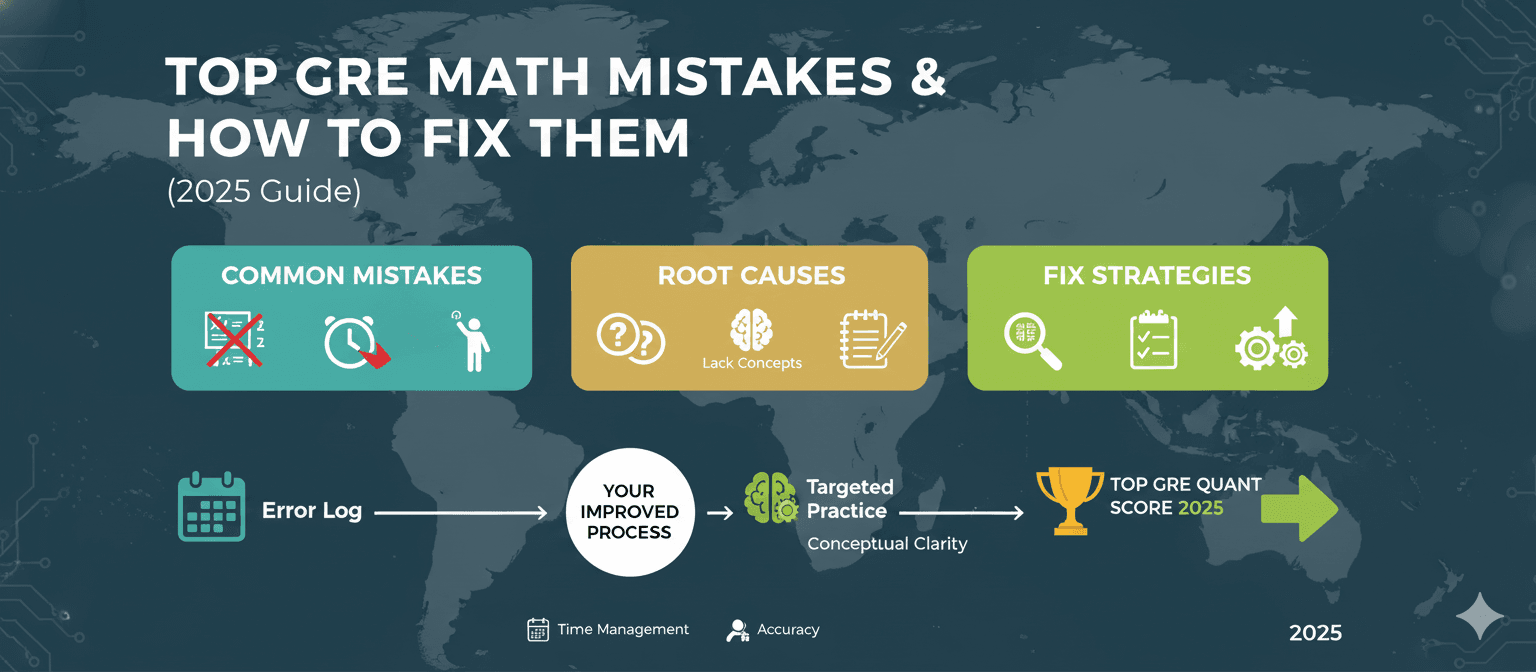
Introduction
You've studied the formulas. You've practised hundreds of questions. Yet on test day, you find yourself losing points on problems you know how to solve.
Sound familiar?
The GRE Quantitative section isn't just about knowing math—it's about avoiding traps that the test deliberately sets for you. Most aspirants lose 3-5 points simply due to preventable mistakes, not lack of knowledge.
This guide walks you through the most common GRE math mistakes and, more importantly, how to fix them before they cost you your target score.
Mistake #1: Misreading the Question
The Problem:
You solve the problem perfectly—except you answered what x is when the question asked for 2x + 1.
This happens more often than you'd think, especially under time pressure. The GRE question writers know this and intentionally place "trap answers" that match what you'd get if you misread.
The Fix:
Circle or underline what the question is actually asking for before you start solving. Make it a habit. On scratch paper, write down the exact variable or expression you need to find.
If the question asks "What is the value of 3y?", write "Find: 3y" at the top of your work.
Mistake #2: Skipping the Units
The Problem:
The question gives you a speed in kilometres per hour, but the answer choices are in metres per second. Or you calculate an area in square metres when the options are in square centimetres.
Unit conversion errors are silent killers on the GRE. You do all the math correctly, but your answer doesn't match any option—or worse, it matches a trap answer.
The Fix:
Before you solve, scan the answer choices to see what units they're in. If conversion is needed, do it first, not last.
Write the conversion factor on your scratch paper. For example: "1 hour = 3,600 seconds" or "1 km = 1,000 m". Then convert before you calculate.
Mistake #3: Forgetting Negative Numbers and Zero
The Problem:
The question says "If x² = 9, what is x?" Most test-takers immediately write x = 3 and move on.
But x could also be -3. And in Quantitative Comparison questions, forgetting negative possibilities or zero can lead you to choose "Quantity A is greater" when the correct answer is "The relationship cannot be determined."
The Fix:
Whenever you see variables, ask yourself: "Could this be negative? Could this be zero? Could this be a fraction?"
Test edge cases, especially in Quantitative Comparison. If the question doesn't specify that a number is positive or an integer, assume it could be anything.
Mistake #4: Rushing Through Word Problems
The Problem:
Word problems on the GRE are intentionally wordy and sometimes confusing. When you're racing against the clock, it's tempting to skim and start calculating.
But if you misunderstand what the problem is asking, all your calculations are pointless.
The Fix:
Slow down for the first 20 seconds. Read the entire problem carefully, then summarise it in your own words or simple notation.
For example, if the problem says "A train leaves Station A at 10 AM travelling at 60 km/h, and another train leaves Station B at 11 AM travelling at 80 km/h," write:
Train A: 10 AM, 60 km/h
Train B: 11 AM, 80 km/h
This takes 10 extra seconds but saves you from re-reading the problem multiple times.
Mistake #5: Overlooking "Could Be" vs "Must Be"
The Problem:
The GRE loves questions that ask "which of the following could be true?" versus "which of the following must be true?"
Aspirants often confuse the two. If something could be true, you only need one example. If it must be true, it has to work in every case.
The Fix:
Highlight the word "could" or "must" in the question. Then test with different numbers.
For "could be" questions, you're looking for at least one scenario where it works.
For "must be" questions, you're looking for scenarios where it doesn't work—if you find one, that answer is wrong.
Mistake #6: Ignoring Figures and Diagrams
The Problem:
The GRE provides a diagram, but you try to solve the problem purely algebraically without referring to it. Or you assume the diagram is to scale when it clearly says "Figure not drawn to scale."
The Fix:
If a diagram is provided, use it. Write values directly on the figure. Mark equal sides, label angles, shade regions.
And always read the fine print. If it says "not drawn to scale," don't rely on visual estimation. A triangle that looks like 45-45-90 might actually be 30-60-90.
Mistake #7: Not Using the Answer Choices
The Problem:
You approach every problem algebraically, even when plugging in the answer choices would be faster and easier.
Many GRE questions are designed to be solved by working backwards from the answers, especially "which of the following" questions.
The Fix:
Before diving into algebra, glance at the answer choices. Are they simple numbers? Try plugging them in.
Start with (B) or (D) if the choices are in ascending order. If the result is too small, you know whether to go higher or lower.
This strategy saves time and reduces calculation errors.
Mistake #8: Calculator Over-Reliance
The Problem:
The GRE allows an on-screen calculator, but many students use it for every single calculation, including simple ones like 5 × 4.
This slows you down and increases the chance of input errors.
The Fix:
Use the calculator strategically for complex calculations or large numbers. For basic arithmetic, do it mentally or on scratch paper.
Practice mental math regularly. The faster you can calculate 15% of 80 or simplify 36/48 in your head, the more time you'll have for actual problem-solving.
Bonus Tip: Review Your Scratch Work
If you finish a section early, don't just sit there. Go back and check your scratch work for silly errors—did you copy a number wrong? Did you drop a negative sign?
These 30 seconds of review can save you from losing easy points.
Final Thoughts
The GRE Quantitative section doesn't just test what you know—it tests how carefully you apply what you know.
Most mistakes aren't about difficulty. They're about attention, strategy, and practice. The good news? These are entirely fixable.
As you prepare, keep a log of your mistakes. Notice patterns. Are you always misreading questions? Forgetting negatives? Skipping units? Once you know your weak spots, you can drill them specifically.
Some aspirants find it easier to stay consistent using structured practice tools like PrepAiro, which helps identify recurring error patterns and suggests targeted fixes.
But regardless of your study method, remember this: every mistake you make in practice is one less mistake you'll make on test day. So review, reflect, and keep refining your approach.
Your target score is within reach—you just need to stop giving away points on problems you already know how to solve.
FAQ Section
Q1: What is the most common mistake students make on GRE math?
Misreading the question is the single most common error. Students solve for the wrong variable or expression because they don't carefully read what the question is actually asking for. Always underline or circle what you need to find before solving.
Q2: How can I avoid silly calculation mistakes on the GRE?
Write neatly, double-check your scratch work, and avoid over-relying on the calculator for simple math. Also, if you finish early, review your answers quickly to catch any copying or sign errors.
Q3: Should I always test negative numbers and zero on the GRE?
Yes, especially in Quantitative Comparison and "which of the following" questions. Unless the problem explicitly states a variable is positive or an integer, always consider negatives, zero, and fractions as possible values.
Q4: Is it better to use algebra or plug in answer choices?
It depends on the question. If the answer choices are simple numbers and the problem asks "what is the value of x?", plugging in answers is often faster. If the question is conceptual or has variables in the choices, algebra is usually better.
Q5: How do I manage time pressure without making careless mistakes?
Slow down for the first 15-20 seconds of each problem to fully understand what's being asked. This prevents costly re-reading later. Also, practice timed sections regularly so you build both speed and accuracy under pressure.
Q6: What should I do if my answer doesn't match any of the choices?
First, check if you misread the question or made a unit conversion error. Then review your calculations for sign errors or dropped values. If you're still stuck, eliminate clearly wrong answers and make an educated guess rather than spending too much time on one question.
Table of content
Share
Written By

Suggested Posts

The Accuracy Trap: Why the Shorter GRE Punishes Old Study Habits — and How to Rewire Your Prep Strategy
Mar 31, 2026

GRE Score Validity & Sending Scores 2026: When Scores Expire, ScoreSelect Strategy & Smart Reporting
Mar 18, 2026

GRE for Indian Students 2026: Complete Guide to Eligibility, Fees, Preparation Tips & Common Mistakes
Mar 18, 2026

Designing Your GRE Study Plan: From Target Scores to Tracking Progress
Mar 13, 2026

GRE Syllabus 2026: All Topics & Question Types Demystified
Mar 13, 2026

GRE Costs & Policies: Exam Fees, Retakes & Score Reporting Explained
Mar 13, 2026

GRE Quantitative Reasoning 2026: The Complete Strategy Guide
Mar 13, 2026

GRE Analytical Writing 2026: Complete Guide, Templates & Scoring
Mar 13, 2026

GRE Scores for Top Universities 2026
Mar 13, 2026

GRE At Home vs Test Center 2026: Complete Comparison + Which One Is Right for You (India Guide)
Mar 13, 2026