Targeted GRE Practice: Why Random Questions Waste Your Time (And What Actually Works)
7 min read
Jan 21, 2026
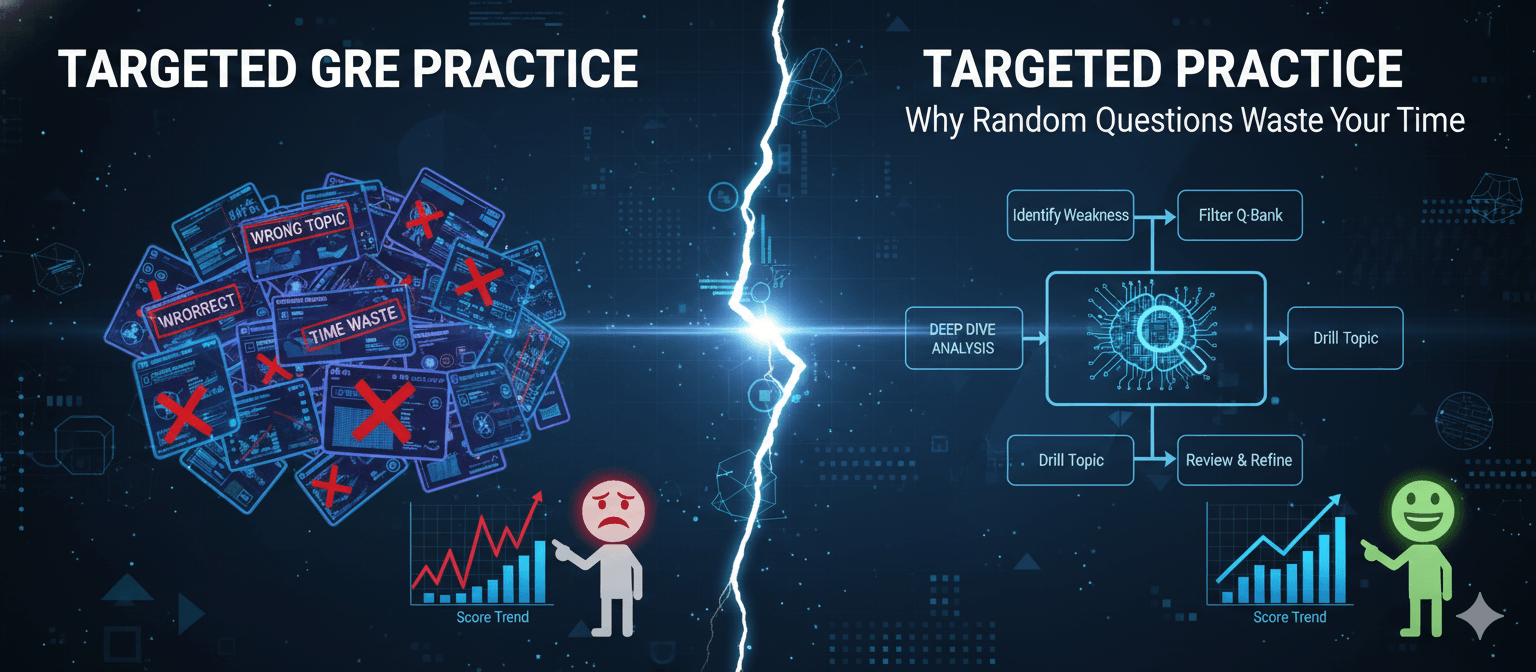
You've probably experienced this frustrating cycle: spend three hours grinding through random GRE practice questions, check your score, and realize you've barely improved. You're not alone, and more importantly, you're not doing anything wrong intellectually. You're simply fighting against how your brain actually learns.
The conventional wisdom of "more practice equals better scores" ignores a fundamental truth that cognitive science has confirmed for over a century: what you practice matters exponentially more than how much you practice. This distinction separates test-takers who plateau from those who consistently improve.
The Hidden Cost of Random Practice
When you sit down with a generic GRE question bank and hit "start quiz," you're essentially spinning a roulette wheel. Some questions will challenge genuine weaknesses. Others will test concepts you've already mastered. The problem isn't the individual questions—it's the allocation of your most limited resource: time.
Consider what happens during an hour of random practice. Research from cognitive psychology suggests that approximately 30-40% of questions in an untargeted session address areas where you need genuine improvement. The remaining 60-70% either reinforce what you already know or touch concepts so far outside your current level that the practice yields minimal benefit.
A 2006 study on retrieval practice found that students who engaged in targeted review before high-stakes tests remembered 60% of material, compared to just 40% for those who studied without strategic focus. That 20-percentage-point gap represents the difference between competitive and mediocre GRE scores.
Why Your Brain Rebels Against Random Learning
The forgetting curve, first documented by psychologist Hermann Ebbinghaus in 1885, reveals that memory decay follows predictable patterns. Without strategic intervention, you forget roughly 70% of new information within 24 hours. But here's what makes this relevant to GRE prep: the rate of forgetting varies dramatically based on your existing knowledge architecture.
When you encounter a GRE problem type you've seen twenty times, your brain processes it through well-established neural pathways. Practicing this problem type again provides diminishing returns—you're reinforcing what's already solid while your actual weak areas continue decaying unaddressed.
Conversely, when you encounter a problem type where you have genuine gaps, your brain must work harder to encode the solution patterns. This "desirable difficulty," as researchers call it, creates stronger memory traces. The key insight: your weak areas require disproportionately more practice time, not equal time distributed across all topics.
The Retrieval Practice Effect: Why Testing Beats Studying
Most GRE preparation treats practice questions as assessment tools—ways to check whether you've learned something. Cognitive science reveals a more powerful truth: the act of retrieving information strengthens memory more effectively than passive review.
This phenomenon, known as the testing effect, has been replicated across hundreds of studies. When you attempt to solve a problem from memory, you're not just measuring knowledge—you're actively building it. The mental effort of retrieval creates encoding pathways that simply reading explanations cannot replicate.
The implication for GRE practice is significant. Random question sets dilute the retrieval benefit by mixing high-value practice (weak areas requiring effortful retrieval) with low-value practice (strong areas requiring minimal mental effort). Targeted practice concentrates the retrieval effect where it matters most.
What Targeted GRE Practice Actually Looks Like
Effective targeted practice requires three components that random question banks cannot provide: diagnostic identification of weak areas, strategic question selection based on those weaknesses, and continuous recalibration as your skills evolve.
Diagnostic Identification goes beyond simple accuracy metrics. Two students might both miss 30% of reading comprehension questions, but for entirely different reasons. One struggles with inference questions while excelling at main idea identification. The other reverses that pattern. Treating them identically wastes both students' time.
Strategic Question Selection means serving questions at the appropriate difficulty level for each specific weakness. A student who consistently misses hard probability questions needs medium-difficulty probability problems first, building foundation before tackling advanced variations. Random selection ignores this progression entirely.
Continuous Recalibration acknowledges that your weak areas shift as you improve. The probability questions that challenged you last week might become comfortable after focused practice, while a previously stable area like sentence equivalence reveals new gaps. Static study plans cannot adapt to this dynamic reality.
The Spacing Effect: Timing Matters as Much as Targeting
Beyond what you practice, when you practice determines long-term retention. The spacing effect—one of the most robust findings in learning science—demonstrates that distributed practice dramatically outperforms concentrated cramming.
Research shows that spacing practice sessions across multiple days, rather than massing them into single sessions, produces superior long-term retention. The effect is so consistent that researchers have developed mathematical models predicting optimal review intervals for different types of material.
For GRE preparation, this means your weak areas need revisiting at strategically calculated intervals. Practice a challenging concept today, return to it in three days, then again in a week. This expanding schedule fights the forgetting curve precisely when decay threatens to undo your progress.
Random practice cannot implement spacing because it treats all questions as interchangeable. Targeted systems track your performance on specific concepts and schedule reviews based on your individual forgetting patterns, not arbitrary session structures.
The AI Advantage in Identifying Weak Areas
Human self-assessment of learning tends to be unreliable. Studies consistently show that students overestimate their understanding of material they've recently reviewed and underestimate mastery of concepts they haven't seen in a while. This "illusion of competence" makes self-directed targeting inherently flawed.
AI-powered analysis removes this subjective bias by tracking granular performance patterns across thousands of data points. Rather than relying on gut feelings about what needs work, algorithmic analysis identifies weakness clusters that might escape conscious notice.
For example, you might recognize that you struggle with "geometry questions," but AI analysis might reveal the specific weakness: problems combining circle properties with coordinate geometry, particularly when the circle isn't centered at the origin. This precision enables practice targeting that generic category awareness cannot achieve.
PrepAiro's approach to this challenge involves continuous performance analytics that map your specific weakness profile, automatically generating practice sets weighted toward your highest-impact improvement areas. The system adapts in real-time as your performance patterns shift, ensuring you're always practicing what matters most.
Building Your Own Targeted Practice System
Whether you use AI assistance or construct a manual system, effective targeting requires honest performance tracking. After each practice session, categorize every missed question by specific topic and question type. Pattern recognition across sessions reveals your genuine weak areas far more accurately than occasional self-reflection.
Create a weakness hierarchy ranking your struggle areas from most to least severe. Allocate practice time proportionally—your worst area deserves triple the attention of your moderate weaknesses. Resist the temptation to practice comfortable topics; the psychological satisfaction of correct answers doesn't translate to score improvement.
Implement deliberate spacing by maintaining a review calendar. When you successfully work through a weak area, don't abandon it. Schedule return visits at expanding intervals: three days, one week, two weeks. Only concepts that survive multiple spaced retrievals have truly become strengths.
The Compound Effect of Targeted Practice
Small targeting improvements compound dramatically over typical GRE preparation timelines. Imagine two students preparing for twelve weeks. Student A practices randomly, improving efficiency by 0% because equal time goes to all areas. Student B targets weak areas specifically, improving efficiency by just 15% by concentrating effort where it matters.
After twelve weeks, Student B has accumulated the equivalent of nearly fourteen weeks of effective practice compared to Student A's twelve. That two-week advantage—gained without any additional study time—often represents the margin between good and great scores.
The psychological benefits compound as well. Targeted practice produces visible progress because you're repeatedly testing areas where improvement is possible. Random practice often feels stagnant because strong-area performance masks weak-area struggles. Sustained motivation through visible progress keeps students engaged through the challenging middle weeks of preparation.
Moving Beyond Random: Your Next Steps
The shift from random to targeted practice doesn't require dramatic changes to your study schedule. Start by auditing your current approach: after your next practice session, categorize every question by topic and difficulty. Notice where your errors cluster. That cluster represents your highest-return practice investment.
Build a simple tracking system—even a spreadsheet works—logging your accuracy by specific question type over time. After two weeks, patterns will emerge that no amount of random practice could reveal. Those patterns become your targeting roadmap.
Consider whether your current practice tools support targeting or fight against it. Generic question banks optimized for volume rather than precision may feel productive while delivering suboptimal results. Tools built around adaptive targeting and performance analytics—like PrepAiro's custom question selection system—align your practice structure with cognitive science principles.
The GRE rewards efficient preparation, not merely extensive preparation. Every hour spent practicing randomly is an hour that could have been spent practicing strategically. The students who achieve top scores rarely work harder than everyone else; they work smarter, targeting their efforts where improvement compounds fastest.
Your weak areas are waiting. The question isn't whether you'll practice—it's whether that practice will count.
Frequently Asked Questions
How do I identify my GRE weak areas without AI tools?
Start with diagnostic practice tests from official ETS materials and track every missed question by specific topic (not just "math" or "verbal," but "probability with combinatorics" or "sentence equivalence with difficult vocabulary"). After three practice sessions, your error patterns reveal genuine weakness clusters. The topics where you consistently lose points—regardless of question difficulty—deserve concentrated attention.
How much practice time should I spend on weak areas versus maintaining strengths?
Research suggests allocating approximately 70% of practice time to weak areas and 30% to maintaining strong areas. Complete abandonment of strengths risks regression, but the marginal benefit of practicing comfortable topics pales compared to addressing genuine gaps. If you have limited study time, shift even more aggressively toward targeting weaknesses.
Does targeted practice work for GRE vocabulary, or only math?
Targeted practice proves equally effective for vocabulary, though the mechanism differs slightly. Instead of practicing problem-solving techniques, you're reinforcing word-meaning associations at strategically spaced intervals. Focus vocabulary practice on words you've seen but cannot reliably recall, not words you've already mastered or words so obscure they're unlikely to appear on test day.
How long before I see results from switching to targeted practice?
Most students notice measurable improvement within two to three weeks of consistent targeted practice. Initial gains often appear in the specific areas you've targeted, with broader score improvements following as multiple weak areas strengthen simultaneously. The key is consistency—sporadic targeting produces sporadic results.
Can I combine targeted practice with full-length practice tests?
Absolutely, and you should. Full-length tests serve different purposes than targeted practice: they build stamina, simulate test conditions, and reveal weakness areas you might have overlooked. Use full-length tests diagnostically every two to three weeks, then return to targeted practice addressing whatever gaps the test revealed.
Table of content
Share
Written By

Suggested Posts

The Accuracy Trap: Why the Shorter GRE Punishes Old Study Habits — and How to Rewire Your Prep Strategy
Mar 31, 2026

GRE Score Validity & Sending Scores 2026: When Scores Expire, ScoreSelect Strategy & Smart Reporting
Mar 18, 2026

GRE for Indian Students 2026: Complete Guide to Eligibility, Fees, Preparation Tips & Common Mistakes
Mar 18, 2026

Designing Your GRE Study Plan: From Target Scores to Tracking Progress
Mar 13, 2026

GRE Syllabus 2026: All Topics & Question Types Demystified
Mar 13, 2026

GRE Costs & Policies: Exam Fees, Retakes & Score Reporting Explained
Mar 13, 2026

GRE Quantitative Reasoning 2026: The Complete Strategy Guide
Mar 13, 2026

GRE Analytical Writing 2026: Complete Guide, Templates & Scoring
Mar 13, 2026

GRE Scores for Top Universities 2026
Mar 13, 2026

GRE At Home vs Test Center 2026: Complete Comparison + Which One Is Right for You (India Guide)
Mar 13, 2026