Master GRE Text Completion & Sentence Equivalence | Guide
5 min read
Dec 23, 2025
Introduction
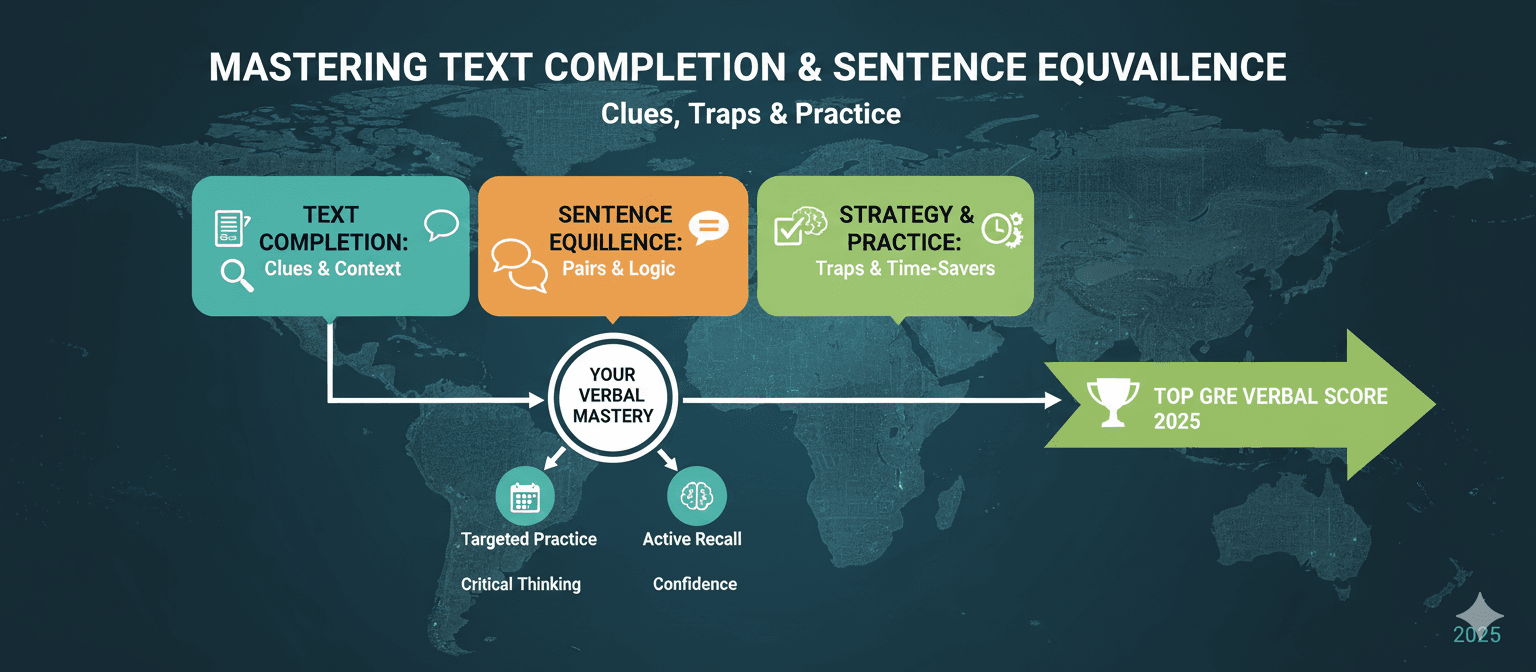
Text Completion (TC) and Sentence Equivalence (SE) questions form the backbone of GRE Verbal Reasoning. Yet, many aspirants find themselves second-guessing answers or falling into carefully designed traps. The good news? These question types follow predictable patterns, and once you learn to spot context clues and avoid common pitfalls, your accuracy improves dramatically.
This guide will teach you how to recognise patterns, decode context clues, and navigate the most frequent traps in TC and SE questions.
Understanding the Question Types
Text Completion presents sentences with one to three blanks. Your job is to select words that complete the sentence logically and maintain its overall meaning.
Sentence Equivalence gives you a single-blank sentence and six answer choices. You must select two words that produce sentences with similar meanings.
The key difference? TC tests your ability to follow a sentence's logical flow across multiple blanks, while SE specifically tests vocabulary precision and synonym recognition.
The Power of Context Clues
Context clues are your roadmap to the correct answer. Most GRE sentences contain specific signals that point you toward the intended meaning.
Transition Words and Contrast Signals
Words like "however," "although," "despite," and "nevertheless" indicate a shift in direction. When you spot these, expect the blank to contrast with information already provided.
Example pattern: "Although the research was ________, the conclusions remained controversial."
Here, "although" signals contrast. If conclusions are controversial despite something about the research, the blank likely describes something positive (thorough, rigorous, comprehensive).
Support and Continuation Signals
Words like "furthermore," "additionally," "indeed," and "similarly" suggest the blank will align with or reinforce previous content.
Semicolons often work this way too—they connect closely related ideas without explicitly stating the relationship.
Cause-and-Effect Indicators
Phrases like "because," "therefore," "as a result," and "consequently" create logical chains. Understanding the cause helps you predict the effect, and vice versa.
Pattern Recognition Strategies
Read the Entire Sentence First
Never jump straight to the blank. Read the complete sentence to grasp its overall meaning and tone. This prevents you from selecting a word that works locally but fails contextually.
Predict Before You Look
Before examining answer choices, predict what type of word should fill the blank. Think about tone (positive/negative), intensity (mild/strong), and general meaning. This mental anchor prevents answer choices from swaying your judgment.
Look for Definition Clues
Sometimes the sentence explicitly defines what the blank should be. Phrases like "that is," "in other words," or "namely" often introduce these clarifications.
Identify Parallel Structure
GRE sentences frequently use parallel construction. If you see "not only X but also Y" or "both X and Y," the words filling blanks X and Y should be similar in tone and meaning.
Common Traps and How to Avoid Them
The Partial Fit Trap
This is where an answer choice seems to work for part of the sentence but fails when you consider the complete context. Always verify your selection against the entire sentence, not just the immediate surrounding words.
The Vocabulary Confusion Trap
GRE loves words that sound similar or have related but distinct meanings (like "deprecate" vs. "depreciate"). Don't select a word just because it looks familiar—ensure you know its precise meaning.
The Extreme Word Trap
Sometimes test-makers include words that are too strong or too weak for the context. A sentence about mild criticism won't use words like "denounced" or "vilified." Calibrate intensity carefully.
The SE Similarity Illusion
In Sentence Equivalence, both correct answers must produce sentences with truly similar meanings, not just grammatically correct ones. After selecting your two answers, read both complete sentences aloud. If they don't convey essentially the same message, reconsider.
Practical Practice Techniques
Analyse Your Mistakes
Don't just note that you got a question wrong. Identify which context clue you missed or which trap you fell into. This meta-analysis builds pattern recognition faster than volume practice alone.
Build a Personal Trap Log
Maintain a document where you note recurring mistakes. Do you frequently misread contrast signals? Do you select words that are too extreme? Awareness is half the battle.
Practice Active Prediction
Make prediction a non-negotiable habit. For every practice question, write down your prediction before looking at choices. Over time, your predictions will become more accurate and faster.
Use Quality Practice Materials
Not all practice questions are created equal. Official GRE materials and well-designed preparation resources reflect actual test patterns. Some aspirants structure their daily practice using tools like PrepAiro to ensure they're consistently working with test-realistic questions.
Time Management Tips
TC and SE questions should take about 1-1.5 minutes each. If you're taking longer:
- You might be over-analysing. Trust your first instinct when you've followed a systematic approach.
- You might lack familiarity with vocabulary. This points to a need for focused word learning.
- You might be reading passively. Engage actively with context clues from your first read.
Building Confidence Through Consistency
Pattern recognition improves through repetition, but quality matters more than quantity. Doing 50 rushed questions won't help as much as 15 questions done mindfully, with full analysis of your reasoning process.
Set realistic daily targets. Even 10 questions analysed thoroughly will compound into significant improvement over weeks.
Conclusion
Text Completion and Sentence Equivalence aren't about having an encyclopaedic vocabulary—though a strong vocabulary certainly helps. They're about learning to read strategically, recognising patterns, and avoiding predictable traps.
Start by slowing down. Read actively for context clues. Predict before you look at answers. Verify your selections against the complete sentence. And most importantly, learn from every mistake. These habits, practised consistently, will transform your approach to GRE Verbal Reasoning.
The patterns are there. You just need to train your eye to see them.
Written By

Suggested Posts

The Accuracy Trap: Why the Shorter GRE Punishes Old Study Habits — and How to Rewire Your Prep Strategy
Mar 31, 2026

GRE Score Validity & Sending Scores 2026: When Scores Expire, ScoreSelect Strategy & Smart Reporting
Mar 18, 2026

GRE for Indian Students 2026: Complete Guide to Eligibility, Fees, Preparation Tips & Common Mistakes
Mar 18, 2026

Designing Your GRE Study Plan: From Target Scores to Tracking Progress
Mar 13, 2026
GRE Syllabus 2026: All Topics & Question Types Demystified
Mar 13, 2026

GRE Costs & Policies: Exam Fees, Retakes & Score Reporting Explained
Mar 13, 2026
GRE Quantitative Reasoning 2026: The Complete Strategy Guide
Mar 13, 2026
GRE Analytical Writing 2026: Complete Guide, Templates & Scoring
Mar 13, 2026

GRE Scores for Top Universities 2026
Mar 13, 2026

GRE At Home vs Test Center 2026: Complete Comparison + Which One Is Right for You (India Guide)
Mar 13, 2026