UPSC CSE Resource Management: The Complete Guide to Smart Preparation
9 min read
Nov 28, 2025

Common Problems Aspirants Face
The UPSC Civil Services Examination demands extensive preparation, but one of the biggest challenges isn't the syllabus itself—it's choosing the right resources. Every year, thousands of aspirants fall into common traps that derail their preparation:
1. Resource Confusion Most aspirants struggle to identify which books and materials are genuinely useful. Without proper guidance, they waste precious months on substandard resources that don't align with UPSC's requirements.
2. The Quality Crisis The market is flooded with UPSC preparation materials, but not all are created equal. Many students discover too late that they've invested time in resources that lack depth, accuracy, or exam relevance.
3. Resource Overload Syndrome The typical aspirant's study table tells a concerning story:
- Multiple NCERTs scattered around
- 3-4 different books for the same topic
- Printed coaching materials from various institutes
- Downloaded PDFs and online notes
- Current affairs compilations from multiple sources
- Random internet articles and YouTube video notes
This overload creates a paralyzing situation where consolidation becomes impossible, and revision turns into a nightmare.
4. The "Book Collector" Phenomenon There's a popular saying in UPSC circles: "Don't become a Book Collector, become a District Collector." This perfectly captures how students get tempted by every new book that promises shortcuts or claims to be the "ultimate guide." The result? Shelves full of books but minds empty of consolidated knowledge.
5. The Time Trap Attempting to read standard books cover-to-cover without understanding what's relevant leads to massive time wastage. Many topics in these books, while interesting, have zero utility for the examination.
The Solution: Smart Resource Management
The Golden Principle: Less is More
The most successful candidates follow one fundamental rule: Limited Resources, Multiple Revisions. It's better to read one good book five times than five books once.
The Three-Tier Resource Framework
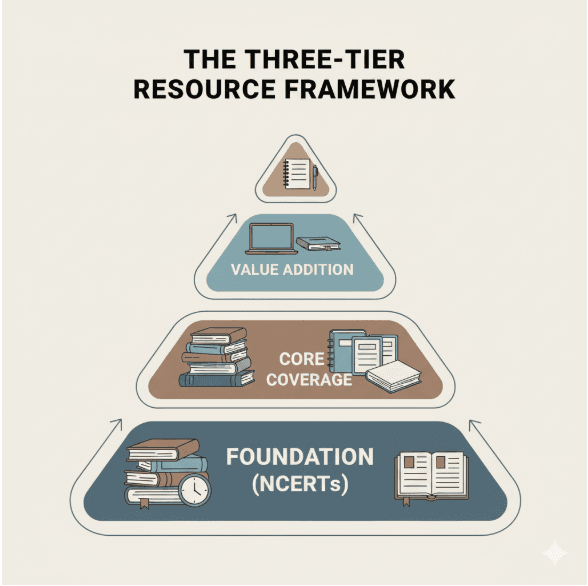
For optimal preparation, organize your resources into three clear categories:
Tier 1: Foundation (NCERTs)
- Purpose: Build conceptual clarity and basic understanding
- Coverage: Class 6-12 NCERTs for relevant subjects
- Time Investment: 2-3 months initially, quick revisions later
Tier 2: Core Coverage (Standard Books)
- Purpose: Comprehensive subject mastery
- Rule: ONE standard book per subject—no exceptions
- Selection: Choose books recommended by recent toppers
- Focus: This becomes your primary revision source
Tier 3: Value Addition
- Components:
Coaching notes (if enrolled) or self-prepared notes
Current affairs integration
Select portions from reference books
Government reports and authentic websites
Previous Year Questions (PYQs) analysis
Test series learnings
Approach: Add these insights to your standard book/notes
Implementation Strategy
Step 1: Create Your Fixed Resource List
Before starting preparation, finalize your resource list. Use the comprehensive table provided below as a guide, but remember—once chosen, stick to it. Resist the temptation to switch books mid-preparation.
Step 2: The Consolidation Method
Choose ONE core source for each subject (either a standard book or your comprehensive notes) and make it your "mother source." All additional information should be added to this single source through:
- Sticky notes
- Margin notes
- Supplementary pages
- Highlighting and underlining
Step 3: The Revision Pyramid
First Reading: Complete and thorough (100% content)
Second Reading: Focus on important sections (70% content)
Third Reading: Key concepts and marked portions (50% content)
Pre-exam Revision: Quick recall points (30% content)
Step 4: Current Affairs Integration
Don't maintain separate current affairs notes. Instead:
- Add current developments to relevant chapters in your standard books
- Link static concepts with contemporary examples
- Create issue-based notes combining static and current dimensions
Red Flags to Avoid
Don't Fall For:
- "New and Revolutionary" Books: Stick to time-tested resources
- Multiple Sources for Same Topic: Creates confusion, not clarity
- Shortcut Compilations: No substitute for standard books
- Excessive Online Material: Information overload without structure
- Peer Pressure Resources: What works for others might not work for you
Warning Signs You're Off Track:
- Buying new books every month
- Unable to complete one revision
- Spending more time collecting materials than studying
- Confusion about what to revise before exams
- Notes scattered across multiple notebooks and folders
The Success Formula
Quality > Quantity: One excellent resource thoroughly understood beats ten average resources partially read.
Consistency > Intensity: Daily 6-8 hours with fixed resources beats sporadic 12-hour sessions with random materials.
Revision > New Reading: After initial preparation, prioritize revision over exploring new materials.
Understanding > Memorization: Focus on conceptual clarity from limited resources rather than rote learning from multiple sources.
Final Wisdom
Remember, UPSC tests your understanding, analytical ability, and expression—not your ability to collect resources. The toppers who succeed aren't those with the most books, but those who extract maximum value from minimum resources.
Your resource list should be like a constitution—amendment should be rare and only when absolutely necessary. Once you've chosen your resources using the comprehensive table below, trust the process and focus on execution rather than exploration.
The path to becoming a civil servant isn't paved with numerous books—it's built on the strong foundation of a few good resources, revisited until they become part of your intellectual DNA.
Your Resource Bible: The Complete UPSC CSE Booklist
UPSC CSE Booklist_Resource List for GS Prelims and Mains.pdf
Use this table as your definitive guide, but remember—it's not about having all these resources, it's about choosing ONE from each category and mastering it completely. The table provides options; your job is to select wisely and commit fully.
Remember: In UPSC preparation, the winner isn't who reads the most, but who retains and reproduces the best. Choose wisely, stick to your choices, and revise relentlessly. Your future in civil services depends not on the number of books you own, but on the depth of knowledge you develop from the few you choose to master.
Written By

Suggested Posts
The Accuracy Trap: Why the Shorter GRE Punishes Old Study Habits — and How to Rewire Your Prep Strategy
Mar 31, 2026

GRE Score Validity & Sending Scores 2026: When Scores Expire, ScoreSelect Strategy & Smart Reporting
Mar 18, 2026
GRE for Indian Students 2026: Complete Guide to Eligibility, Fees, Preparation Tips & Common Mistakes
Mar 18, 2026
Designing Your GRE Study Plan: From Target Scores to Tracking Progress
Mar 13, 2026
GRE Syllabus 2026: All Topics & Question Types Demystified
Mar 13, 2026
GRE Costs & Policies: Exam Fees, Retakes & Score Reporting Explained
Mar 13, 2026
GRE Quantitative Reasoning 2026: The Complete Strategy Guide
Mar 13, 2026
GRE Analytical Writing 2026: Complete Guide, Templates & Scoring
Mar 13, 2026

GRE Scores for Top Universities 2026
Mar 13, 2026

GRE At Home vs Test Center 2026: Complete Comparison + Which One Is Right for You (India Guide)
Mar 13, 2026