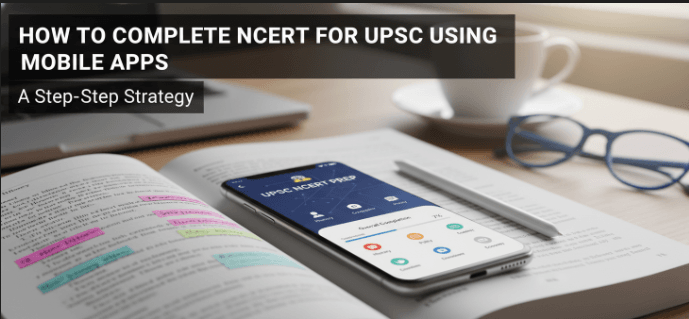
How to Complete NCERT for UPSC Using Mobile Apps: A Step-by-Step Strategy
8 min read
Mar 17, 2026
1. Introduction
Every UPSC aspirant has heard it a thousand times: start with NCERT. And for good reason. NCERT textbooks form the bedrock of General Studies, covering History, Geography, Polity, Economics, and Science in a structured, exam-aligned manner. UPSC examiners consistently draw questions — both direct and conceptual — from these foundational texts.
But here lies the challenge: completing NCERT for UPSC means reading through more than 40 books spanning Classes 6 to 12. For a working professional, a college student managing academics, or a first-generation aspirant with limited guidance, this feels overwhelming before preparation even begins.
This is where mobile apps change the game. The best UPSC apps for preparation in India today offer video summaries, chapter-wise notes, built-in quizzes, and progress tracking — all designed specifically to make NCERT completion structured, measurable, and far less daunting. In this guide, we walk you through exactly how to use these tools, step by step.
2. Why NCERT First?
The Union Public Service Commission (UPSC) sets questions that test conceptual clarity, not just rote memorisation. NCERT textbooks are crafted to build exactly this clarity — using simple language, logical structure, and carefully chosen examples. They are the common language between aspirant and examiner.
UPSC's Love for Basic Concepts
Questions in both the Prelims and Mains repeatedly trace back to NCERT-level understanding. Consider these examples from recent years:
- A Prelims 2022 question on the Indus Valley Civilisation drew directly from Class 6 History (Our Past – I)
- Geography questions on monsoon patterns and river systems closely mirror Class 9 and 10 Geography NCERT chapters
- Polity questions on Fundamental Rights, Directive Principles, and Constitutional bodies align precisely with Laxmikant — but Laxmikant itself recommends reading NCERT Class 11 Political Science first
Advanced books like India's Struggle for Independence by Bipan Chandra or Indian Economy by Ramesh Singh assume you already understand the NCERT framework. Starting with advanced texts without this base is like building a house without a foundation — it will not hold.
The rule is simple: NCERT first, advanced books second. There are no shortcuts here — but there are smarter ways to get through it.
3. The NCERT Subjects You Must Cover
Not all NCERT books carry equal weight for UPSC. Here is a subject-wise breakdown of what to read, which classes to prioritise, and why each matters.
📚 History (Classes 6–12) — Highest Priority
| Class | Book Title | Key Topics |
|---|---|---|
| 6 | Our Past – I | Ancient India: Indus Valley, Vedic Age |
| 7 | Our Past – II | Medieval India: Delhi Sultanate, Mughals |
| 8 | Our Past – III | Modern India begins: 1857, colonial economy |
| 9 | India and the Contemporary World – I | French Revolution, Nazism, Pastoralism |
| 10 | India and the Contemporary World – II | Nationalism, Industrialisation, Print Culture |
| 11 | Themes in World History | Ancient civilisations, modern world origins |
| 12 | Themes in Indian History – Parts I, II, III | In-depth ancient to modern — most critical for Mains |
🌍 Geography (Classes 6–12) — Highest Priority
| Class | Book Title | Key Topics |
|---|---|---|
| 6 | The Earth: Our Habitat | Basics of physical geography |
| 7 | Our Environment | Ecosystems, natural zones |
| 8 | Resources and Development | Land use, agriculture, industries |
| 9 | Contemporary India – I | India's physical features, drainage, climate |
| 10 | Contemporary India – II | Resources, agriculture, manufacturing, transport |
| 11 | Fundamentals of Physical Geography + India: Physical Environment | Atmosphere, landforms, India's terrain |
| 12 | Human Geography + India: People and Economy | Population, migration, economic geography |
⚖️ Polity (Classes 9–12) — High Priority
- Class 9: Democratic Politics – I (Elections, constitutional design)
- Class 10: Democratic Politics – II (Power sharing, federalism, political parties)
- Class 11: Political Theory + Indian Constitution at Work
- Class 12: Politics in India since Independence (most important for GS-II)
💰 Economics (Classes 9–12) — High Priority
- Class 9: Economics (Poverty, food security, India's economic story)
- Class 10: Understanding Economic Development
- Class 11: Indian Economic Development (Five-year plans, liberalisation)
- Class 12: Macro and Microeconomics — essential for Economic Survey linkage
🔬 Science (Classes 6–10) — Moderate Priority
- Focus areas: Human body, nutrition, diseases, space, environment, energy
- Class 10 Science chapters on heredity, carbon compounds, and the environment are frequently tested
- Skip Class 11–12 Science (too deep; not UPSC-relevant at that level)
4. How Mobile Apps Simplify NCERT Preparation
Reading 40+ textbooks cover-to-cover the traditional way is inefficient for most aspirants. The top mobile applications for UPSC exam preparation solve this with four core features:
🎥 Video Summaries — Faster Than Reading
A 30-page NCERT chapter condensed into a 15-minute video is not a shortcut — it is smart learning. Visual explanation of maps, timelines, and diagrams is far more effective than reading static text. Apps like PrepAiro offer chapter-wise video lessons for every NCERT book from Class 6 to 12, letting you cover material in a fraction of the time.
📝 Chapter-Wise Notes — Ready for Quick Revision
Taking notes while reading entire books is time-consuming. Well-structured apps provide pre-made, exam-focused notes for each NCERT chapter. These are not just summaries — they highlight what UPSC is likely to ask, with key terms, dates, constitutional articles, and concepts flagged explicitly.
✅ Quizzes After Each Chapter — Retention That Sticks
Research in cognitive science consistently shows that active recall through quizzes is far more effective than passive rereading. After completing a chapter on PrepAiro, chapter-wise quizzes test your understanding in real time — identifying gaps while the content is still fresh in your memory.
📊 Progress Tracking — Stay Motivated for the Long Haul
UPSC preparation is a marathon, and motivation dips are inevitable. Progress dashboards in quality apps let you see exactly how many chapters you have covered, which subjects need more attention, and how your quiz scores are trending. This kind of data-driven feedback keeps you accountable and helps you plan study sessions more intelligently.
🟢 PrepAiro — Full NCERT Coverage in One App
- ✓ Video lessons for every chapter, Classes 6–12 across all 5 subjects
- ✓ Chapter-wise notes formatted for UPSC relevance
- ✓ Quizzes after every chapter with instant feedback
- ✓ Progress tracking dashboard with subject-wise analytics
- ✓ Free tier includes full NCERT content — no paywall to get started
5. Step-by-Step NCERT Completion Strategy
Here is a structured 4-month plan to complete NCERT using mobile apps systematically. The schedule is realistic for aspirants studying 4–5 hours daily.
Phase 1 (Month 1–2): History + Polity
| Week | Target |
|---|---|
| Week 1–2 | History Classes 6–8 (ancient to colonial basics) |
| Week 3 | History Classes 9–10 |
| Week 4–6 | History Class 12 — Parts I, II, III (most critical) |
| Week 5–8 | Polity Classes 9–11 (interleaved with History) |
Daily target: 2 chapters + chapter quiz. Use app quizzes at the end of every chapter before moving forward.
Phase 2 (Month 2–3): Geography + Economics
| Week | Target |
|---|---|
| Week 1–3 | Geography Classes 6–10 |
| Week 4–5 | Geography Classes 11–12 |
| Week 5–6 | Economics Classes 9–10 |
| Week 7–8 | Economics Classes 11–12 |
Focus: Use map-based questions from app quizzes especially for Geography. Rivers, mountain ranges, and natural regions must be practised on maps, not just read.
Phase 3 (Month 3–4): Science + Full Revision
| Week | Target |
|---|---|
| Week 1–3 | Science Classes 6–10 (prioritise Class 10) |
| Week 3–8 | Full NCERT revision using app notes and chapter quizzes exclusively |
Revision goal: Re-attempt all chapter quizzes and aim to score above 80%. Use the progress tracker to identify the weakest chapters for focused re-reading.
🗓️ Daily App Usage Routine
| Time Slot | Activity |
|---|---|
| Morning (60–90 min) | Watch 2 video summaries on the app |
| Afternoon (30 min) | Read chapter notes on the app — add personal annotations |
| Evening (30 min) | Attempt chapter quizzes for the day's videos |
| Night (15 min) | Review progress dashboard; plan tomorrow's chapters |
The power of this approach is in its structure. Rather than opening a textbook and reading passively, you have a defined daily target, active learning through quizzes, and visible progress to sustain motivation.
6. Common NCERT Mistakes to Avoid
Even with the best tools, certain preparation errors repeatedly hold aspirants back. Here are the most common ones — and how to avoid them:
-
Skipping lower classes (6–8): Many aspirants assume early classes are too basic. They are not. Ancient history, foundational geography, and basic economics from Classes 6–8 form the factual bedrock that UPSC tests indirectly in higher-order questions.
-
Not making notes: Even when using app notes, adding your own annotations reinforces memory. Passive reading — even of excellent summaries — is not enough. Write keywords, draw quick timelines, note page numbers of diagrams.
-
Reading without practising questions: NCERT is preparation input; UPSC is output. Without regularly practising questions from what you have read, you cannot gauge retention or exam readiness. Use chapter quizzes after every single chapter, without exception.
-
Ignoring maps and diagrams: UPSC Geography and History regularly test map-based knowledge. Rivers, mountain ranges, historical sites, colonial boundaries — these appear in Prelims options like "Which of the following pairs is correctly matched?" Always spend time with NCERT maps.
-
Reading NCERT only once: One thorough reading is not enough. Plan at least one complete revision pass using app notes in Month 4. The quiz scores from your revision pass will tell you exactly where your gaps are.
7. Conclusion
Completing NCERT for UPSC is not a superhuman task — it is a planning and consistency challenge. The aspirants who succeed are not necessarily the most intelligent; they are the most organised. With a clear subject priority, a phased month-wise plan, and the right app to structure your daily learning, NCERT completion is entirely within reach.
Mobile apps have fundamentally changed how UPSC preparation happens in India. Video lessons that save hours of reading time, chapter notes that focus your revision, quizzes that lock in retention, and progress tracking that keeps you accountable — these tools make the 40-book NCERT challenge genuinely manageable.
🚀 Start Your NCERT Journey on PrepAiro
Free access to NCERT notes and quizzes for Classes 6–12. Full video coverage across History, Geography, Polity, Economics, and Science. Track your progress chapter by chapter — and finish NCERT in 4 structured months.
PrepAiro is built for UPSC aspirants who want smart, not just hard, preparation.
Written By

Suggested Posts

The Accuracy Trap: Why the Shorter GRE Punishes Old Study Habits — and How to Rewire Your Prep Strategy
Mar 31, 2026

GRE Score Validity & Sending Scores 2026: When Scores Expire, ScoreSelect Strategy & Smart Reporting
Mar 18, 2026
GRE for Indian Students 2026: Complete Guide to Eligibility, Fees, Preparation Tips & Common Mistakes
Mar 18, 2026

Designing Your GRE Study Plan: From Target Scores to Tracking Progress
Mar 13, 2026

GRE Syllabus 2026: All Topics & Question Types Demystified
Mar 13, 2026

GRE Costs & Policies: Exam Fees, Retakes & Score Reporting Explained
Mar 13, 2026

GRE Quantitative Reasoning 2026: The Complete Strategy Guide
Mar 13, 2026

GRE Analytical Writing 2026: Complete Guide, Templates & Scoring
Mar 13, 2026

GRE Scores for Top Universities 2026
Mar 13, 2026

GRE At Home vs Test Center 2026: Complete Comparison + Which One Is Right for You (India Guide)
Mar 13, 2026