How Many GRE Practice Tests Should You Take? (Data-Backed Answer)
6 min read
Jan 21, 2026
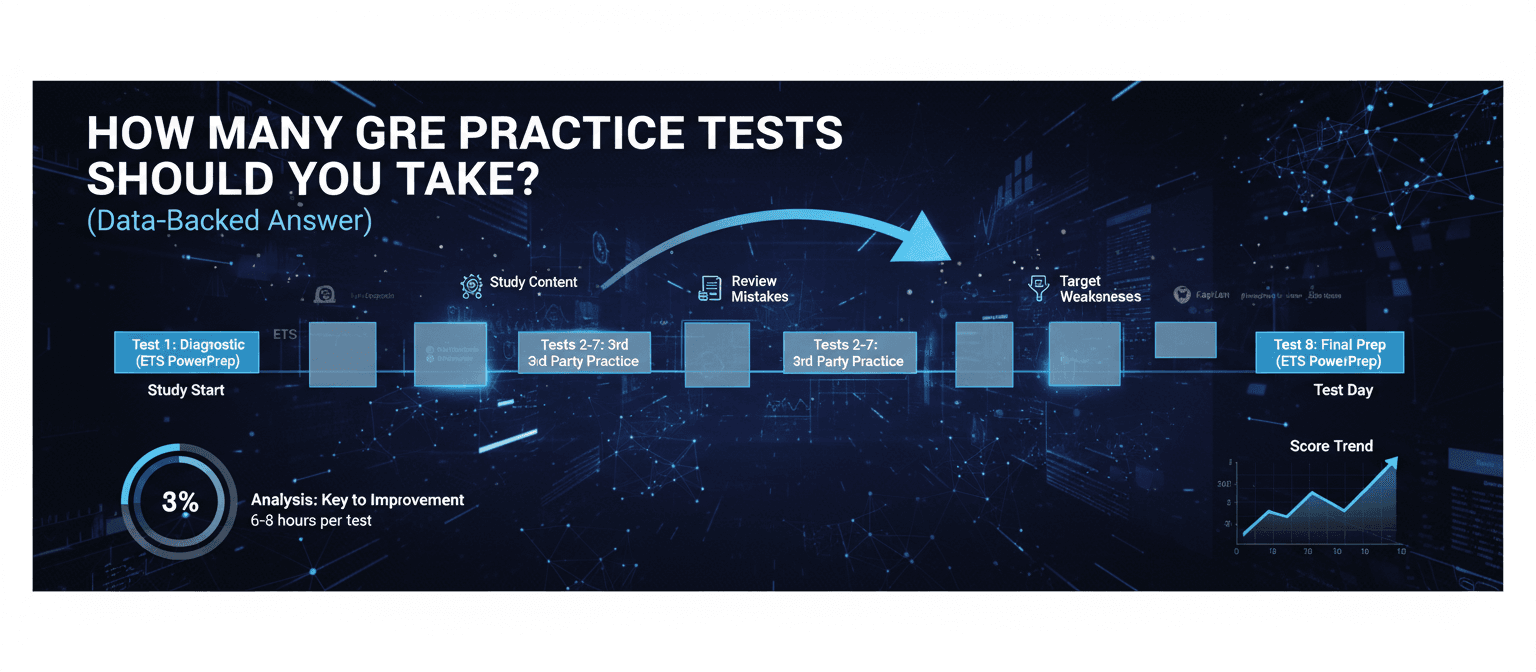
You've started your GRE prep, and now the burning question: how many GRE practice tests should you actually take? Too few and you're flying blind on test day. Too many and you're wasting precious study time that could go toward targeted improvement.
The answer isn't just a number. It's about understanding when practice tests help, when they hurt, and how cognitive science research can guide you toward a smarter approach than simply grinding through mock exams.
The Research-Backed Answer: 5-8 Full-Length Tests for Most Test-Takers
Based on cognitive science research on the testing effect and analysis of prep course structures that produce consistent results, the optimal range for most test-takers is 5 to 8 full-length practice tests over a typical 6-10 week preparation period.
Here's what the data tells us:
Testing frequency research from cognitive psychology shows that retrieval practice (the act of pulling information from memory during tests) significantly enhances long-term retention compared to passive review. A landmark study published in Psychological Science found that students who engaged in repeated retrieval outperformed those who only restudied material, even when the restudying group spent more total time with the content.
However, this research also reveals a critical nuance: the testing effect works best when spaced appropriately and combined with targeted study between tests. Taking practice tests back-to-back without analysis and skill-building between them eliminates most of the cognitive benefit.
Why "More Tests = Better Scores" Is a Dangerous Myth
Many test-takers fall into what we call the "practice test trap": believing that taking 15, 20, or even 30 practice tests will guarantee score improvement. The evidence suggests otherwise.
The law of diminishing returns kicks in hard after 8-10 tests. Here's why:
-
Official tests are limited resources. ETS currently offers only 5 official POWERPREP practice tests (2 free, 3 paid). These are your most valuable diagnostic tools because they're created by the actual test-makers and mirror real GRE difficulty. Burning through them early, before you've built foundational skills, wastes irreplaceable resources.
-
Third-party tests have accuracy problems. Tests from prep companies often don't match real GRE difficulty or question style. Some inflate verbal scores; others present math questions that are unrealistically hard or easy. Using these as your primary benchmark can create false confidence or unnecessary panic.
-
Testing without analysis is passive, not active, learning. Research on test-enhanced learning consistently shows that the benefit comes from the retrieval process combined with feedback processing. If you're simply taking tests, checking your score, and moving on, you're missing the learning mechanism entirely.
The Strategic Practice Test Schedule
Instead of asking "how many," reframe the question as "when and how." Here's a research-backed schedule that maximizes learning while preserving your official test resources:
Week 1: Diagnostic Baseline (1 Test)
Take one full-length practice test before diving into content review. Use a free third-party test (like Manhattan Prep's free diagnostic) for this initial benchmark, saving your official ETS tests for later.
Purpose: Establish your starting point across Verbal, Quant, and AWA. Identify whether your gaps are foundational (missing core concepts) or strategic (poor time management, wrong approach to question types).
Weeks 2-4: Skill Building Phase (1-2 Tests)
After 2-3 weeks of targeted content study, take your first official practice test (ETS POWERPREP Practice Test 1). Space additional tests at least 7-10 days apart during this phase.
Between each test:
- Review every incorrect answer, not just to see what was right, but to understand the reasoning
- Categorize mistakes: content gap vs. careless error vs. time pressure
- Spend 3-4x more time analyzing than you spent taking the test
Weeks 5-7: Refinement Phase (2-3 Tests)
This is where practice tests become most valuable. You've built foundational skills; now you're calibrating your approach.
Key principle: Research on spaced practice shows that gaps between tests allow consolidation and prevent "testing fatigue" that can actually decrease performance.
Week 8-10: Peak Performance Phase (1-2 Tests)
Reserve your final official practice tests for this window. Take one test 7-10 days before your actual GRE, and one 2-3 days before (if you have tests remaining).
Critical rule: Your final practice test should be under real conditions—timed, no interruptions, at the same time of day as your actual test.
What the Cognitive Science Actually Says About Practice Testing
The "testing effect," sometimes called retrieval practice, is one of the most robust findings in learning science. Here's what decades of research reveals that most prep advice misses:
1. Retrieval strengthens memory traces more than re-studying does.
A study from Washington University demonstrated that students who took practice tests on material remembered 50% more one week later compared to students who spent the same time re-reading. But the mechanism isn't magical—it's about the mental effort of pulling information from memory.
2. Spacing beats massing.
Multiple studies confirm that distributed practice (tests spread over time) produces stronger long-term retention than massed practice (multiple tests in a short period). For GRE prep, this means taking one practice test per week is more effective than taking three tests in one week.
3. Feedback timing matters.
Research published in the Proceedings of the National Academy of Sciences shows that immediate feedback after retrieval enhances learning more than delayed feedback. When you take a practice test, review it the same day, not three days later.
4. Difficulty is desirable (to a point).
Cognitive scientists call this "desirable difficulty"—learning is enhanced when retrieval is challenging but achievable. If you're scoring 85% on practice tests consistently, you need harder material or different question types. If you're scoring 30%, the tests are too difficult to provide useful feedback.
The Mistake Analysis Protocol That Actually Works
Taking the right number of tests matters less than how you analyze each one. Here's a systematic approach based on deliberate practice research:
Step 1: Immediate Emotional Debrief (5 minutes)
Right after finishing, note which sections felt harder, where time pressure hit, and your overall confidence. This emotional data often reveals patterns your score alone won't show.
Step 2: Categorize Every Wrong Answer
Go beyond "I got this wrong" to understand why:
- Content gap: You didn't know the concept or vocabulary
- Misread: You understood the concept but missed a detail in the question
- Process error: Your approach was inefficient or incorrect
- Time pressure: You knew how to solve it but ran out of time
- Careless: Simple arithmetic or reading mistake
Step 3: Identify Patterns Across Tests
After 2-3 tests, patterns emerge. Maybe you consistently miss sentence equivalence questions with negative relationships, or algebra problems involving rates. These patterns become your study priorities.
This is where targeted practice becomes invaluable. Instead of taking another full practice test, you need intensive work on your specific weak areas. Platforms like PrepAiro excel here by using AI to identify exactly which question types trip you up and generating custom practice sets focused on those patterns—something generic practice tests can't provide.
Step 4: Create "Mistake Flashcards"
For each significant error, create a flashcard not with the question, but with the thinking pattern that led to the mistake. "Remember: on inference questions, eliminate answers that go beyond what's stated" is more useful than memorizing a single question.
How Many Official ETS Tests Are Available?
Understanding your resources helps you allocate them wisely:
| Test | Cost | Features |
|---|---|---|
| POWERPREP Practice Test 1 | Free | Adaptive, scored, reflects current GRE format |
| POWERPREP Practice Test 2 | Free | Adaptive, scored, different questions from Test 1 |
| POWERPREP PLUS Test 1 | $39.95 | Includes answer explanations and essay scoring |
| POWERPREP PLUS Test 2 | $39.95 | Includes answer explanations and essay scoring |
| POWERPREP PLUS Test 3 | $39.95 | Includes answer explanations and essay scoring |
Total official tests: 5 (2 free, 3 paid)
This scarcity is why treating practice tests as learning tools, not just score predictors, matters so much. Each official test represents roughly 20% of your highest-quality diagnostic resources.
When to Take More (or Fewer) Tests
The 5-8 test recommendation isn't universal. Adjust based on:
Take More Tests If:
- You're studying for 3+ months and need periodic benchmarks
- Your score variance between tests is high (10+ points), indicating inconsistent performance
- You struggle specifically with test-day conditions (timing, stamina, pressure)
Take Fewer Tests If:
- Your prep window is under 4 weeks—prioritize targeted practice over testing
- You consistently hit your goal score on practice tests—you're ready
- You find yourself "practicing" tests without analyzing them (you're not learning, just testing)
The Final Week: Test Strategy vs. Test Quantity
One week before your actual GRE, resist the urge to cram in extra practice tests. Research on peak performance suggests a taper period is more effective:
7 days before: Final full-length practice test under real conditions 5-6 days before: Light review focusing on your highest-impact weak areas 3-4 days before: Mixed practice with no new content, reinforcing what you know 2 days before: Brief review, confidence building, rest 1 day before: Complete rest—no studying, no practice questions
Your brain needs consolidation time. The gains from one more practice test are far outweighed by the cost of arriving at your actual GRE mentally fatigued.
Beyond Practice Tests: What Drives Real Score Improvement
Practice tests measure progress—they don't create it. The activities between tests determine whether your score actually moves:
Content mastery: Do you understand the underlying concepts, or are you pattern-matching?
Strategy refinement: Are you using efficient approaches to each question type?
Weakness targeting: Are you systematically addressing your specific gaps, or hoping general practice will cover them?
This is exactly why tools that analyze your performance at the question-type level provide more value than another generic practice test. When PrepAiro's AI identifies that you're missing Data Interpretation questions involving percentage change calculations, you can drill specifically on that skill rather than taking another 2-hour test hoping a few relevant questions appear.
Key Takeaways
The optimal number of GRE practice tests for most test-takers is 5-8 over 6-10 weeks. But the number matters far less than:
- Spacing tests appropriately (7-10 days apart minimum)
- Analyzing deeply (spend 3x longer reviewing than testing)
- Targeting weaknesses between tests with focused practice
- Preserving official tests for your refinement and peak phases
- Trusting diminishing returns after 8-10 tests
The testing effect is real science, but it works through effort, spacing, and feedback—not raw test volume. Your goal isn't to become great at taking practice tests. It's to walk into the testing center knowing exactly what to expect and confident in your ability to execute.
Frequently Asked Questions
Is it okay to retake the same GRE practice test?
Yes, but with caveats. After 2-3 weeks, retaking allows you to practice timing and conditions, though your score will be inflated since you've seen the questions. Never use a retake score as an accurate predictor.
Should I take practice tests timed or untimed?
Always timed for diagnostic purposes. Untimed practice is useful for learning new concepts, but your official tests must simulate real conditions to provide accurate benchmarks.
How many days before the GRE should I stop taking practice tests?
Take your final practice test 2-3 days before. Use the last 48 hours for rest and light review only.
Can I use unofficial practice tests as substitutes for ETS tests?
Use them for additional practice, but trust official ETS tests for accurate score prediction. Third-party tests vary significantly in quality and GRE-realism.
What if my practice test scores aren't improving?
Stagnant scores usually indicate insufficient targeted practice between tests. Focus on your specific weak areas rather than taking more full-length tests.
Table of content
Share
Written By

Suggested Posts

The Accuracy Trap: Why the Shorter GRE Punishes Old Study Habits — and How to Rewire Your Prep Strategy
Mar 31, 2026

GRE Score Validity & Sending Scores 2026: When Scores Expire, ScoreSelect Strategy & Smart Reporting
Mar 18, 2026

GRE for Indian Students 2026: Complete Guide to Eligibility, Fees, Preparation Tips & Common Mistakes
Mar 18, 2026

Designing Your GRE Study Plan: From Target Scores to Tracking Progress
Mar 13, 2026

GRE Syllabus 2026: All Topics & Question Types Demystified
Mar 13, 2026

GRE Costs & Policies: Exam Fees, Retakes & Score Reporting Explained
Mar 13, 2026

GRE Quantitative Reasoning 2026: The Complete Strategy Guide
Mar 13, 2026

GRE Analytical Writing 2026: Complete Guide, Templates & Scoring
Mar 13, 2026

GRE Scores for Top Universities 2026
Mar 13, 2026

GRE At Home vs Test Center 2026: Complete Comparison + Which One Is Right for You (India Guide)
Mar 13, 2026