GRE Weak Areas: How to Identify and Target Them for Maximum Score Gains
7 min read
Jan 21, 2026
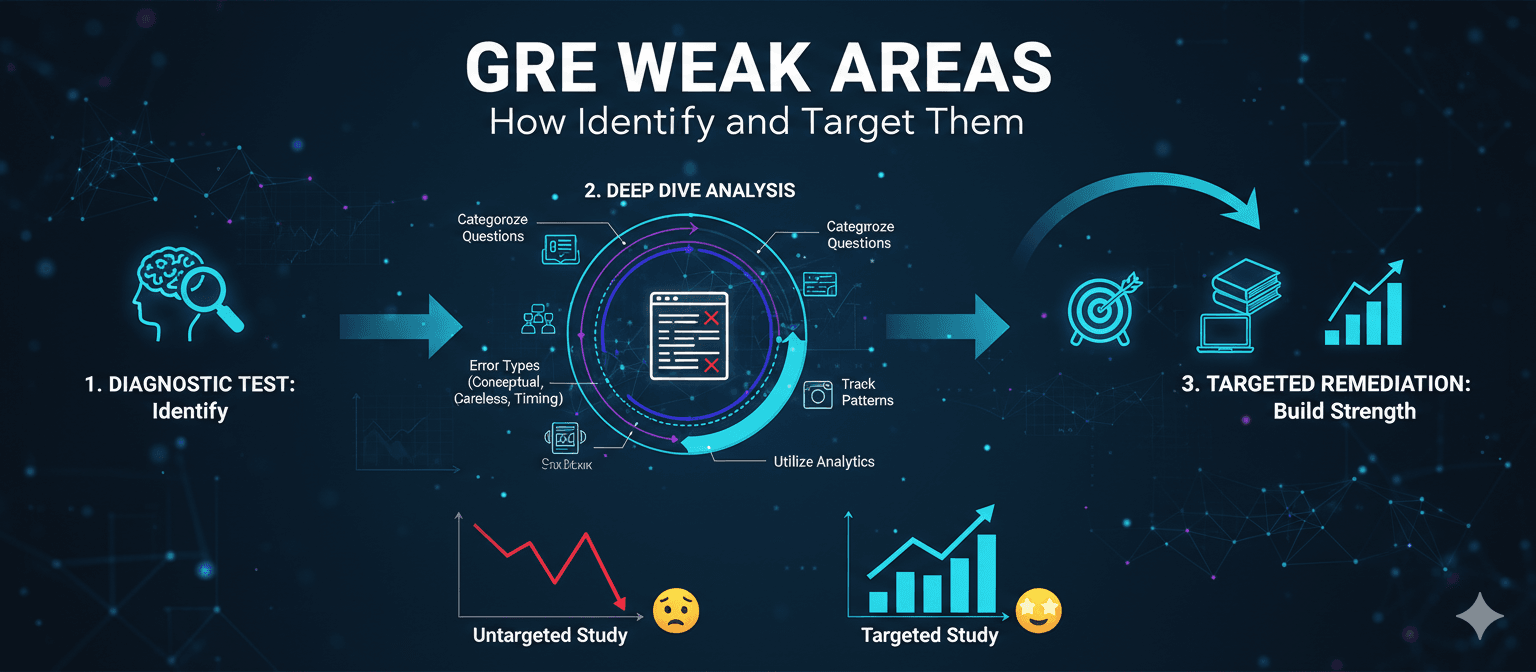
Most GRE test-takers make the same critical mistake: they practice everything equally. They work through hundreds of questions across all topics, hoping broad exposure will somehow translate into higher scores. The research tells a different story. According to K. Anders Ericsson's landmark studies on deliberate practice, learners who focus specifically on their weaknesses improve at three to five times the rate of those who practice randomly.
The challenge isn't motivation or effort. It's diagnosis. You can't fix what you can't identify, and the GRE's adaptive structure makes pinpointing your actual weak areas surprisingly difficult without the right approach.
This guide walks you through exactly how to identify your GRE weak areas with precision and build targeted practice sessions that address them directly.
Why Generic Practice Fails (And What Actually Works)
The GRE isn't testing whether you've memorized math formulas or vocabulary lists. It's testing whether you can apply reasoning skills under time pressure. This distinction matters because it means your weak areas probably aren't what you think they are.
A student struggling with geometry questions might assume they need to review geometric formulas. In reality, their weakness might be visualizing problems or recognizing when to apply auxiliary lines. Someone missing Reading Comprehension questions might not have a vocabulary problem at all—they might struggle with inference questions specifically or lose track of passage structure in longer texts.
Research published in the Journal of Educational Psychology found that self-assessment of academic weaknesses is notoriously inaccurate. Students tend to overestimate their abilities in areas they find interesting and underestimate them in areas that feel tedious. The result is misallocated study time that feels productive but doesn't move scores.
Effective GRE preparation requires objective data about your performance patterns, not subjective impressions of where you "feel" weak.
The Four-Layer Framework for Identifying GRE Weak Areas
Your GRE weak areas exist at multiple levels, and addressing only the surface layer leaves deeper problems untouched. Think of weakness identification as peeling back layers.
Layer One: Section-Level Weaknesses The broadest category is your relative performance across the three GRE sections. Are you stronger in Quantitative Reasoning or Verbal Reasoning? How does your Analytical Writing compare? A diagnostic test provides this high-level view immediately.
Layer Two: Question-Type Weaknesses Within each section, different question types test different skills. Quantitative Reasoning includes Quantitative Comparison, Problem Solving, and Data Interpretation questions. Verbal Reasoning tests Text Completion, Sentence Equivalence, and Reading Comprehension. Your accuracy varies across these types more than you realize.
Layer Three: Content-Area Weaknesses Drilling deeper, each question type draws from specific content areas. Quantitative Reasoning covers arithmetic, algebra, geometry, and data analysis. Verbal passages span humanities, social sciences, and natural sciences. Your performance on rate problems differs from your performance on probability problems.
Layer Four: Skill-Based Weaknesses The deepest layer involves the cognitive skills underlying question types. Do you struggle with multi-step reasoning? With eliminating trap answers? With managing time on complex problems? These skill gaps cut across content areas and explain why you might miss questions on topics you "know."
Most test-takers only identify Layer One weaknesses. Meaningful score improvement requires identifying weaknesses at all four layers.
Using Diagnostic Tests to Map Your Weak Areas
A proper diagnostic test serves as your baseline measurement. Without it, you're guessing at your weak areas based on how questions "feel" rather than how you actually perform.
The ideal diagnostic approach involves taking a full-length practice test under realistic conditions. This means timing each section strictly, avoiding breaks you wouldn't take on test day, and completing the entire test in one sitting. Anything less produces skewed data.
After completing the diagnostic, resist the urge to simply check your scores. The raw numbers tell you very little. Instead, analyze your results by categorizing every question you missed or found difficult. Create a simple tracking system with columns for question number, section, question type, content area, time spent, and reason for error.
The "reason for error" column is the most important and the most neglected. Be honest with yourself. Did you miss that algebra question because you forgot how to factor polynomials, or because you misread the question? Did you run out of time, make a calculation error, or fall for a trap answer? The diagnosis determines the prescription.
After categorizing twenty to thirty missed questions, patterns emerge. You might discover that you consistently struggle with probability questions involving "at least" phrasing. Or that you miss Reading Comprehension questions asking about author's purpose more than questions asking about stated details. These patterns reveal your actual weak areas rather than the generic categories you assumed.
Common GRE Weak Areas by Section
Understanding typical weak areas helps you recognize patterns in your own performance. Here's what the data shows about where most test-takers struggle.
Quantitative Reasoning Weak Areas
Probability and combinatorics trip up test-takers more than any other quant topic. The concepts feel counterintuitive, and small wording changes dramatically alter the approach required.
Word problems involving rates, work, and mixtures cause consistent difficulty because they require translating verbal information into mathematical relationships before solving.
Number properties, particularly questions involving remainders, divisibility, and prime factorization, reveal gaps in foundational understanding that affect multiple question types.
Data Interpretation questions requiring synthesis across multiple charts or graphs expose weaknesses in information processing under time pressure.
Verbal Reasoning Weak Areas
Reading Comprehension inference questions challenge test-takers who read too literally or struggle to distinguish what the passage implies from what it states directly.
Text Completion questions with three blanks multiply the difficulty because you must hold multiple context clues in working memory simultaneously while evaluating answer choices.
Sentence Equivalence questions test vocabulary depth, not just vocabulary breadth. Knowing that "ephemeral" means temporary doesn't help if you can't distinguish it from "fleeting," "transient," and "evanescent."
Passages from unfamiliar disciplines, particularly dense philosophical or scientific writing, slow reading speed and comprehension even for test-takers with strong verbal skills.
Analytical Writing Weak Areas
Argument analysis essays suffer when test-takers confuse weakening an argument with disagreeing with its conclusion. The task asks you to evaluate reasoning, not debate positions.
Time management derails essay quality when test-takers spend too long planning or too little time revising. The thirty-minute constraint requires efficiency that feels uncomfortable without practice.
Building Targeted Practice Sets That Address Your Weaknesses
Once you've identified specific weak areas, the next step is deliberate practice designed to address them. This differs fundamentally from working through generic question sets.
Deliberate practice for the GRE involves four elements: questions slightly beyond your current ability, immediate feedback on your performance, concentrated attention without distraction, and consistent repetition with variation.
Start by gathering questions that target your identified weak areas specifically. If you struggle with probability questions, you need a set of probability questions at varying difficulty levels—not a random assortment that happens to include some probability.
Work through questions in focused sessions of twenty to thirty minutes. Research on skill acquisition shows that longer sessions produce diminishing returns as attention wanes. Short, intense practice sessions several times per week outperform marathon study sessions.
For each question, don't just check whether you got it right. Examine your reasoning process. Could you have solved it more efficiently? Did you consider the correct approach initially but talk yourself out of it? These process insights matter more than right-wrong tallies.
After completing a targeted practice set, review your error patterns. If you're still struggling with the same weak area after focused practice, you might need to go back to foundational concepts before attempting more questions. Sometimes weak areas persist because prerequisite knowledge is shaky.
AI-powered platforms like PrepAiro can accelerate this process by automatically categorizing your performance, identifying patterns human analysis might miss, and generating custom question sets targeting your specific weak spots. The advantage is precision—algorithms can detect subtle patterns across hundreds of questions that manual tracking would miss.
The Feedback Loop: Tracking Progress on Your Weak Areas
Improvement on weak areas isn't linear. You'll see rapid gains initially, followed by plateaus, followed by breakthrough moments. The key is maintaining a feedback loop that shows you whether your targeted practice is working.
Track your accuracy on weak-area questions separately from your overall practice. If you started at forty percent accuracy on probability questions and you're now hitting sixty percent, that's measurable progress even if your overall quant score hasn't budged yet.
Retake diagnostic tests every three to four weeks to reassess your weak areas. Some will improve while others emerge. The GRE's adaptive structure means that as you strengthen one area, you'll start seeing harder questions in that area—which might reveal new, more nuanced weak spots.
Don't abandon a weak area just because you've achieved slight improvement. The goal isn't adequate performance; it's mastery. Keep working on identified weak areas until they become relative strengths.
When to Pivot: Recognizing Diminishing Returns
Not every weak area deserves equal attention. Strategic test preparation means recognizing when further investment in a weak area produces diminishing returns.
If you've spent twenty hours on a specific weak area and seen minimal improvement, consider whether that time might be better invested elsewhere. Some weak areas have ceiling effects—the improvement potential is limited by factors beyond practice, like foundational knowledge gaps that require more fundamental work.
Calculate the score impact of different weak areas. Struggling with three-blank Text Completion questions matters more than struggling with obscure geometry concepts that appear rarely. Focus on high-frequency weak areas before addressing edge cases.
The GRE's adaptive scoring means that weak performance in Section 1 caps your score potential. Weak areas that affect Section 1 performance deserve priority over weak areas that only affect difficult Section 2 questions.
Taking Action on Your GRE Weak Areas
Identifying weak areas without acting on them is academic procrastination disguised as preparation. The insight is worthless without execution.
Your next step is simple: take a diagnostic test. Not next week. Today or tomorrow. Get objective data on where you actually stand rather than where you think you stand.
Then build your four-layer weakness map. Document your section-level, question-type, content-area, and skill-based weak spots. Be specific. "I struggle with quant" isn't actionable. "I miss rate problems involving multiple workers by misassigning variables" is actionable.
Finally, create targeted practice sessions that address your top three weak areas. Twenty focused questions on your specific weak spots will improve your score more than one hundred random questions will.
The test-takers who improve their GRE scores dramatically aren't the ones who study more. They're the ones who study smarter—targeting their actual weak areas with precision rather than hoping generic practice will somehow find and fix their gaps.
Your weak areas are your score improvement waiting to happen. Find them, face them, fix them.
FAQs About GRE Weak Areas
How many weak areas should I focus on at once? Focus on two to three weak areas simultaneously. Trying to address more dilutes your practice intensity and slows improvement on each individual area. Once you've improved a weak area, rotate in a new one.
How long does it take to improve a weak area on the GRE? Most test-takers see measurable improvement on specific weak areas within two to four weeks of focused practice (studying three to four hours weekly on that area). Deeper weaknesses involving foundational concept gaps may take longer.
Should I focus on my weakest area first or my strongest? Start with your weakest high-impact area—the one that affects the most questions you're likely to encounter. This produces the largest score gains fastest. Save low-frequency weak areas for later in your preparation.
Can I identify my weak areas without taking a full practice test? You can identify some weak areas through topical quizzes, but a full-length practice test reveals weakness patterns that shorter assessments miss—particularly timing weaknesses and stamina-related errors that appear late in sections.
What if I'm weak in everything on the GRE? If diagnostic results show weakness across all areas, focus first on foundational skills: basic algebra for quant, vocabulary for verbal, essay structure for writing. Foundational improvements create cascading benefits across multiple weak areas.
Table of content
Share
Written By

Suggested Posts

The Accuracy Trap: Why the Shorter GRE Punishes Old Study Habits — and How to Rewire Your Prep Strategy
Mar 31, 2026

GRE Score Validity & Sending Scores 2026: When Scores Expire, ScoreSelect Strategy & Smart Reporting
Mar 18, 2026

GRE for Indian Students 2026: Complete Guide to Eligibility, Fees, Preparation Tips & Common Mistakes
Mar 18, 2026

Designing Your GRE Study Plan: From Target Scores to Tracking Progress
Mar 13, 2026

GRE Syllabus 2026: All Topics & Question Types Demystified
Mar 13, 2026

GRE Costs & Policies: Exam Fees, Retakes & Score Reporting Explained
Mar 13, 2026

GRE Quantitative Reasoning 2026: The Complete Strategy Guide
Mar 13, 2026

GRE Analytical Writing 2026: Complete Guide, Templates & Scoring
Mar 13, 2026

GRE Scores for Top Universities 2026
Mar 13, 2026

GRE At Home vs Test Center 2026: Complete Comparison + Which One Is Right for You (India Guide)
Mar 13, 2026