Mastering GRE Prep While Working or Studying: Balance, Focus & Flexibility
5 min read
Dec 15, 2025
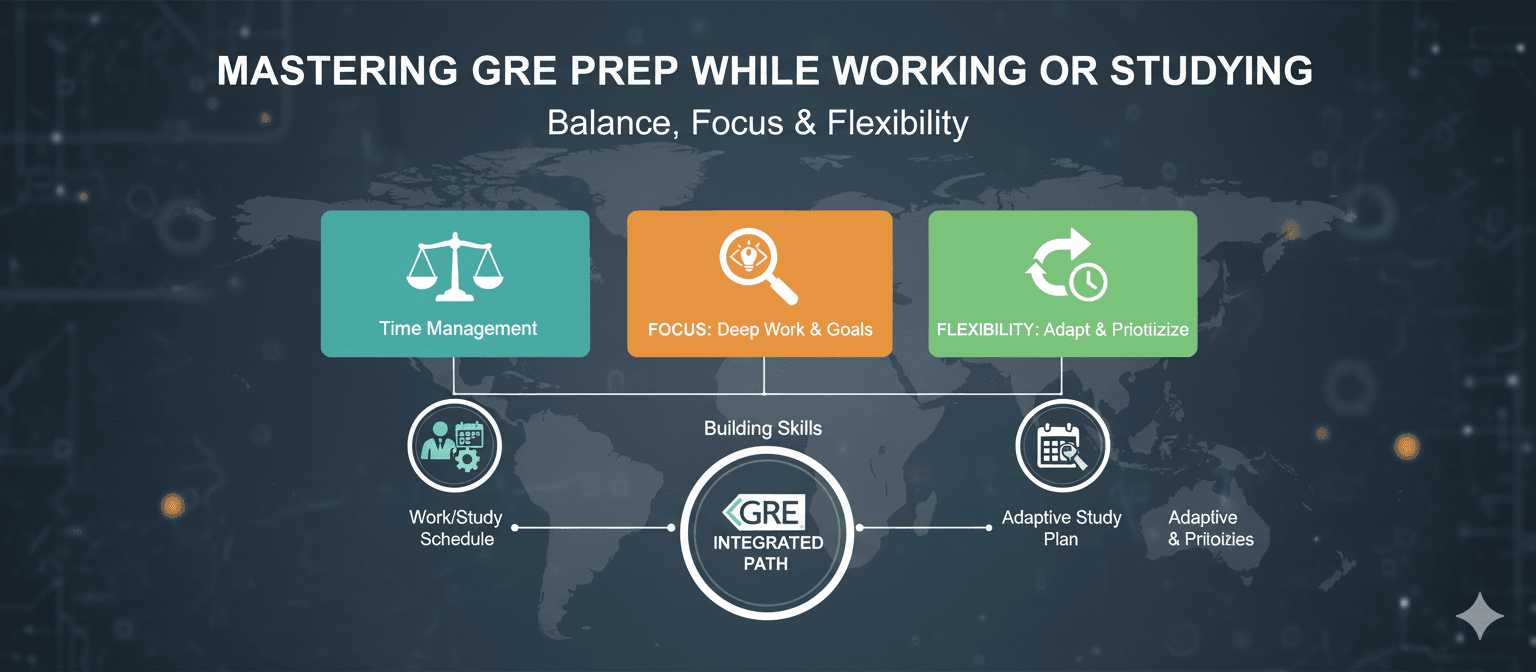
If you're reading this between meetings, during a lunch break, or after a long day of classes, you already know the struggle: preparing for the GRE while managing a demanding schedule feels like trying to solve a Quantitative Comparison question with half the information missing.
Here's the counterintuitive truth that most test prep advice ignores: your busy schedule might actually be working in your favor. Let me explain why and more importantly, how to make it work.
The Shorter GRE Changes Everything
The GRE underwent a significant transformation in 2024, shrinking from a four-hour marathon to a streamlined 1 hour and 58 minutes. This isn't just a convenience it's a cognitive advantage for busy test-takers.
Research on sustained attention shows that cognitive performance degrades significantly after 2-3 hours of continuous mental effort. The previous 4-hour GRE format pushed test-takers into fatigue territory where decision-making quality suffered. The current format keeps you within the window of peak cognitive performance, meaning the score you earn more accurately reflects your actual abilities not your endurance.
For working professionals and students juggling multiple responsibilities, this compressed format also means less time away from your other commitments on test day. You can realistically take the GRE during a morning slot and still make afternoon obligations.
Why Your Fragmented Schedule Might Be a Feature, Not a Bug
Here's where cognitive science offers a surprising insight. According to research by Sean Kang at the University of Melbourne, learning distributed across multiple sessions produces significantly better long-term retention than the same amount of study time crammed into intensive blocks. This phenomenon, known as the spacing effect, has been documented in over 300 studies spanning more than a century.
When you study in shorter, spaced intervals say, 45 minutes before work and 30 minutes during lunch your brain undergoes a process called memory reconsolidation. Each time you return to material after a gap, you're not just reviewing; you're strengthening the neural pathways that encode that knowledge into long-term memory.
The practical implication? Those fragmented pockets of time in your busy schedule are neurologically designed for effective learning. The person who studies 90 minutes daily across three sessions will likely outperform someone who does a single 3-hour session twice a week even though the total study time is lower.
Building Your Flexible Study Framework
Rather than prescribing a rigid schedule that will inevitably collide with real-life demands, consider building a framework that adapts to your rhythm.
Identify your cognitive windows. Most people have 2-3 periods during the day when their mental acuity peaks. For many, this is early morning before the day's demands accumulate, or late evening after decompression time. Pay attention to when you feel most alert over the next week, then protect those windows for GRE study.
Separate learning from practice. New concept acquisition (learning the algebra shortcuts you've forgotten since college, for instance) requires deeper focus than practicing problems you already understand. Reserve your peak cognitive windows for new learning, and use smaller time pockets for practice and review.
Use transition time strategically. The 15 minutes before a meeting starts, the commute, the wait for coffee these moments are perfect for vocabulary review through flashcards or mental rehearsal of problem-solving approaches. Cognitive research suggests these brief retrieval sessions are highly effective for cementing knowledge.
The Working Professional's Timeline
Most preparation experts suggest planning for 8-12 weeks of study when targeting significant score improvement, with approximately 12-15 hours of weekly study time. For someone working full-time, this typically breaks down into 2-3 hours on three weekdays, plus a longer 4-hour session on one weekend day and a shorter 2-hour session on the other.
Here's the crucial point that generic advice misses: consistency matters more than intensity. Studying 1.5 hours daily for six days produces better results than studying 9 hours in a single weekend marathon. Your brain needs time between sessions to consolidate learning—time when you're sleeping, working, or living your life.
If your schedule is truly chaotic, consider extending your preparation timeline rather than compressing your daily commitment. A 16-week preparation period with 8-10 hours weekly may be more sustainable (and ultimately more effective) than a brutal 8-week sprint that leads to burnout.
Managing Competing Priorities
The psychological weight of preparation often exceeds the actual time commitment. Here are strategies that address the mental load:
Communicate boundaries. Let family, roommates, or partners know about your preparation period. Setting expectations reduces the friction of protecting study time and may even generate support—people generally want to help when they understand the stakes.
Leverage your vacation time strategically. Consider taking a few days off during the final two weeks of preparation to focus on practice tests and targeted review. This concentrated effort before test day can cement your preparation without requiring you to sacrifice months of normal life.
Release perfectionism. You don't need to master every obscure vocabulary word or memorize every geometric formula. The GRE tests reasoning patterns more than content recall. Focus on understanding underlying logic, and accept that you'll encounter some questions you're not fully prepared for—everyone does.
The PrepAiro Approach to Adaptive Learning
What makes the difference between productive study and wasted time is targeting your actual weak points. Generic study plans assume all test-takers need the same preparation, but someone who aced high school math but hasn't written analytically in years needs a fundamentally different approach than a liberal arts graduate who hasn't seen an algebra problem in a decade.
Adaptive learning platforms like PrepAiro's analyze your performance patterns to identify not just what you're getting wrong, but why—whether it's a conceptual gap, a time management issue, or a test-taking strategy problem. This precision means your limited study time focuses exactly where it will produce the most score improvement.
Your Next Step
Start by taking a diagnostic practice test to establish your baseline score. Compare this to the score requirements of your target programs, and calculate the gap you need to close. This gives you the data to plan realistically—not based on what some generic advice suggests, but on what your specific situation requires.
The GRE is a reasoning test, not a knowledge test. You're not trying to memorize a textbook; you're developing patterns of analytical thinking that your busy, demanding life has likely already been training you for. Trust the process, respect your constraints, and remember that thousands of working professionals and full-time students earn competitive GRE scores every year.
You can be one of them.
FAQ Section (Structured for Featured Snippets)
How many hours per week should I study for the GRE while working full-time?
Plan for 12-15 hours per week for effective GRE preparation while working. This typically means 2-3 hours on three weekdays plus 4-6 hours on weekends. Consistency matters more than intensity daily study sessions produce better results than weekend cramming.
Can I prepare for the GRE in 2 months while working?
Yes, 8-10 weeks is sufficient preparation time for most working professionals, provided you can commit 12-15 hours weekly. If your schedule is more constrained, consider extending to 12-16 weeks with fewer weekly hours to maintain consistency without burnout.
How long is the GRE test in 2025?
The GRE takes 1 hour and 58 minutes to complete. This includes Analytical Writing (30 min), two Verbal Reasoning sections (18 and 23 min), and two Quantitative Reasoning sections (21 and 26 min). There are no breaks during the exam.
What's the best time of day to study for the GRE?
Study during your personal cognitive peak the time when you feel most mentally alert. For most people, this is early morning before daily demands accumulate or evening after work. Reserve these peak windows for learning new concepts, and use smaller time pockets for review and practice.
Suggested Posts

The Accuracy Trap: Why the Shorter GRE Punishes Old Study Habits — and How to Rewire Your Prep Strategy
Mar 31, 2026

GRE Score Validity & Sending Scores 2026: When Scores Expire, ScoreSelect Strategy & Smart Reporting
Mar 18, 2026

GRE for Indian Students 2026: Complete Guide to Eligibility, Fees, Preparation Tips & Common Mistakes
Mar 18, 2026

Designing Your GRE Study Plan: From Target Scores to Tracking Progress
Mar 13, 2026

GRE Syllabus 2026: All Topics & Question Types Demystified
Mar 13, 2026

GRE Costs & Policies: Exam Fees, Retakes & Score Reporting Explained
Mar 13, 2026

GRE Quantitative Reasoning 2026: The Complete Strategy Guide
Mar 13, 2026

GRE Analytical Writing 2026: Complete Guide, Templates & Scoring
Mar 13, 2026

GRE Scores for Top Universities 2026
Mar 13, 2026

GRE At Home vs Test Center 2026: Complete Comparison + Which One Is Right for You (India Guide)
Mar 13, 2026