GRE Flashcards: Paper vs Anki vs AI-Powered (2025 Comparison)
6 min read
Jan 19, 2026
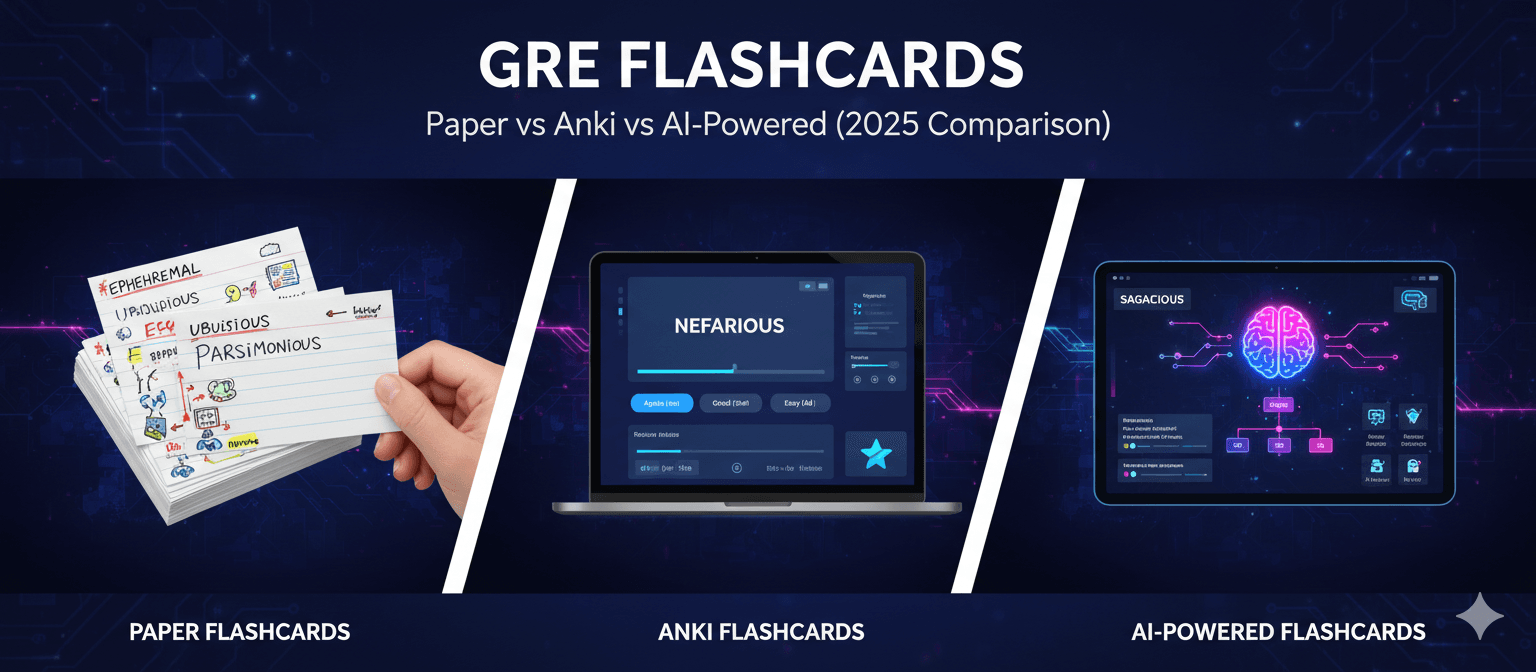
You're staring at a list of 1,000+ GRE vocabulary words, and the question isn't whether to use flashcards—it's which flashcard method will actually work.
The GRE Verbal section tests contextual understanding, not dictionary memorization. Yet most test-takers approach vocabulary prep the same way students have for decades: flip card, read definition, repeat until frustrated. Research from cognitive psychology tells us this approach is fundamentally flawed, but the alternatives can feel overwhelming.
This GRE flashcards comparison breaks down three approaches—traditional paper, Anki-style digital, and AI-powered systems—so you can choose the method that matches your learning style, timeline, and GRE goals.
Understanding How the GRE Actually Tests Vocabulary
Before comparing flashcard methods, it helps to understand what you're preparing for. The GRE doesn't ask you to define words in isolation. Text Completion and Sentence Equivalence questions require you to recognize subtle contextual usage and identify words with overlapping meanings.
Consider the difference between knowing that "perfunctory" means "done without care" versus recognizing it as a synonym for "cursory" while distinguishing it from "superficial" in a specific sentence context. This distinction matters enormously when choosing your flashcard approach.
Paper Flashcards: The Traditional Approach
Paper flashcards remain popular for good reasons. Writing words by hand engages muscle memory and reduces screen fatigue. Physical cards require no battery, no app downloads, and no subscription fees.
Where Paper Works Well: The tactile process of creating cards can reinforce initial learning. A 2025 study published in Cogent Education found that both paper and digital flashcards improved vocabulary retention compared to passive word lists, with paper users reporting reduced distractions during study sessions.
Where Paper Falls Short: Paper flashcards have no built-in system for tracking which words you've mastered versus which need more attention. Most students cycle through their entire deck repeatedly, wasting time on words they already know. For GRE prep specifically, paper cards rarely include contextual sentences, pronunciation, or synonym groups—all critical for Sentence Equivalence success.
The organizational burden also compounds over time. Managing 500+ physical cards across difficulty levels becomes logistically challenging, and there's no automatic way to prioritize words approaching your personal forgetting threshold.
Anki and Traditional Digital Flashcards
Anki has earned its reputation as the gold standard for spaced repetition software. Its algorithm schedules review sessions based on your performance history, showing difficult words more frequently while spacing out cards you've mastered.
Where Anki Excels: The spaced repetition system is genuinely powerful. Research from cognitive science demonstrates that spaced practice produces significantly better long-term retention than massed practice. A meta-analysis of 317 studies confirmed that spaced repetition consistently outperforms cramming for knowledge that needs to persist beyond a few days.
Anki's customization options allow you to add images, audio pronunciations, and multiple example sentences. The platform supports community-shared decks, including GRE-specific collections with thousands of words.
Where Anki Struggles: Anki's learning curve is notoriously steep. The interface prioritizes power-user functionality over intuitive design, and configuring optimal settings requires understanding concepts like "ease factor" and "interval modifier."
More importantly, Anki treats all vocabulary learning identically. It doesn't distinguish between GRE-specific challenges. The algorithm optimizes for raw recall, not for the contextual recognition and synonym pairing the GRE actually tests. You might remember that "garrulous" means "talkative," but Anki won't automatically help you connect it to "loquacious" and "voluble" the way Sentence Equivalence questions demand.
For Indian students specifically, Anki offers no native Hindi explanations—a significant gap when complex English concepts need clarification in your thinking language.
AI-Powered Flashcard Systems
The newest category in GRE flashcards comparison involves AI-driven platforms that go beyond basic spaced repetition. These systems analyze individual learning patterns to create personalized review schedules and content presentation.
The Science Behind Adaptive Learning: Traditional spaced repetition uses predetermined intervals (typically 1 day, then 3 days, then 7 days, and so on). AI-powered systems model your individual forgetting curve based on factors like word complexity, your historical performance with similar words, and time-of-day learning patterns.
Research published in the International Journal of Artificial Intelligence in Education demonstrates that adaptive forgetting curves—adjusted per user and per word—outperform one-size-fits-all approaches for vocabulary retention.
What Sets AI-Powered Systems Apart: The best AI-powered GRE flashcard tools understand that vocabulary learning isn't about isolated word-definition pairs. They present words in synonym clusters relevant to Sentence Equivalence, provide contextual sentences from GRE-style passages, and adapt difficulty based on your demonstrated verbal reasoning level.
PrepAiro's approach exemplifies this evolution. Rather than simply asking whether you know "obdurate," the system presents it alongside "intransigent" and "adamant"—the exact synonym recognition skill Sentence Equivalence requires. For students who think more fluently in Hindi, explanations in your native language can accelerate comprehension of nuanced English concepts without the cognitive tax of processing everything in a second language.
Head-to-Head: Which Method Fits Your GRE Prep?
| Factor | Paper | Anki | AI-Powered |
|---|---|---|---|
| Setup Time | High (manual creation) | Medium (deck downloads available) | Low (pre-built, adaptive) |
| Learning Curve | None | Steep | Minimal |
| Spaced Repetition | Manual tracking required | Algorithm-driven | Personalized algorithm |
| GRE Context | Basic definitions only | Customizable but manual | Built-in Sentence Equivalence focus |
| Cost | Low | Free (desktop), paid (iOS) | Varies by platform |
| Hindi Support | DIY only | Community decks (limited) | Native integration (PrepAiro) |
Choosing Based on Your Timeline
If you have 3+ months: Any method can work with consistent daily practice. Consider starting with paper cards for initial learning, then transitioning to a spaced repetition system for long-term retention.
If you have 1-2 months: Skip paper entirely. You need the efficiency gains from algorithm-driven review scheduling to maximize limited time. AI-powered systems offer the fastest path to GRE-relevant vocabulary mastery.
If you have less than 4 weeks: Focus exclusively on high-frequency GRE words with an AI-powered or Anki-based system. Prioritize synonym clusters over raw word count—knowing 300 words deeply beats recognizing 1,000 words superficially.
The Retention Reality Check
Hermann Ebbinghaus's forgetting curve research from the 1880s remains remarkably relevant: without active review, you'll forget approximately 70% of newly learned information within 24 hours. By one week, retention drops to roughly 20%.
Spaced repetition—whether through Anki's algorithm or AI-powered alternatives—combats this decay by scheduling reviews precisely when memories begin fading. A 2020 University of Leicester study found that students using spaced repetition scored 70% on assessments compared to 64% for those who crammed—a meaningful gap when every GRE Verbal point matters.
Beyond Flashcards: The Bigger Picture
Flashcards build recognition, but GRE success requires application. The students who score 160+ on Verbal don't just know word definitions—they read extensively, practice with official ETS materials, and develop instincts for how words function in academic prose.
Use your flashcard system to build the vocabulary foundation, then reinforce those words through reading practice. When you encounter "sycophantic" in an actual GRE passage, the connection between flashcard recognition and test performance becomes clear.
The best GRE flashcards comparison isn't really about the flashcard method at all—it's about finding the system you'll actually use consistently for the months of preparation ahead.
Frequently Asked Questions
What are the best GRE flashcards for 2025?
The best GRE flashcards depend on your learning style and timeline. AI-powered systems like PrepAiro offer personalized spaced repetition with Sentence Equivalence-focused synonym clusters. Magoosh and Anki remain popular free options, though they require more manual configuration for GRE-specific preparation.
Is Anki good for GRE vocabulary?
Anki is effective for GRE vocabulary thanks to its spaced repetition algorithm, but requires significant setup time and technical configuration. It excels at raw memorization but doesn't specifically address GRE question formats like Sentence Equivalence synonym matching.
How many GRE vocabulary words should I learn?
Focus on 800-1,200 high-frequency GRE words rather than attempting massive word lists. Depth of understanding—including synonyms, antonyms, and contextual usage—matters more than total word count for GRE Verbal success.
Do paper flashcards work for GRE prep?
Paper flashcards can work for initial vocabulary acquisition, but lack the spaced repetition scheduling that digital alternatives provide. Without systematic review intervals, you'll likely waste time re-studying words you already know while neglecting challenging vocabulary.
What's the fastest way to memorize GRE words?
The fastest retention comes from combining spaced repetition with active recall testing. AI-powered flashcard systems automate optimal review scheduling while presenting words in GRE-relevant contexts, making them the most efficient option for time-constrained test-takers.
Table of content
Share
Written By

Suggested Posts

The Accuracy Trap: Why the Shorter GRE Punishes Old Study Habits — and How to Rewire Your Prep Strategy
Mar 31, 2026
GRE Score Validity & Sending Scores 2026: When Scores Expire, ScoreSelect Strategy & Smart Reporting
Mar 18, 2026
GRE for Indian Students 2026: Complete Guide to Eligibility, Fees, Preparation Tips & Common Mistakes
Mar 18, 2026

Designing Your GRE Study Plan: From Target Scores to Tracking Progress
Mar 13, 2026
GRE Syllabus 2026: All Topics & Question Types Demystified
Mar 13, 2026
GRE Costs & Policies: Exam Fees, Retakes & Score Reporting Explained
Mar 13, 2026
GRE Quantitative Reasoning 2026: The Complete Strategy Guide
Mar 13, 2026
GRE Analytical Writing 2026: Complete Guide, Templates & Scoring
Mar 13, 2026

GRE Scores for Top Universities 2026
Mar 13, 2026

GRE At Home vs Test Center 2026: Complete Comparison + Which One Is Right for You (India Guide)
Mar 13, 2026