GRE Analytical Writing 2025: Format, Tasks & Scoring Guide
7 min read
Dec 24, 2025
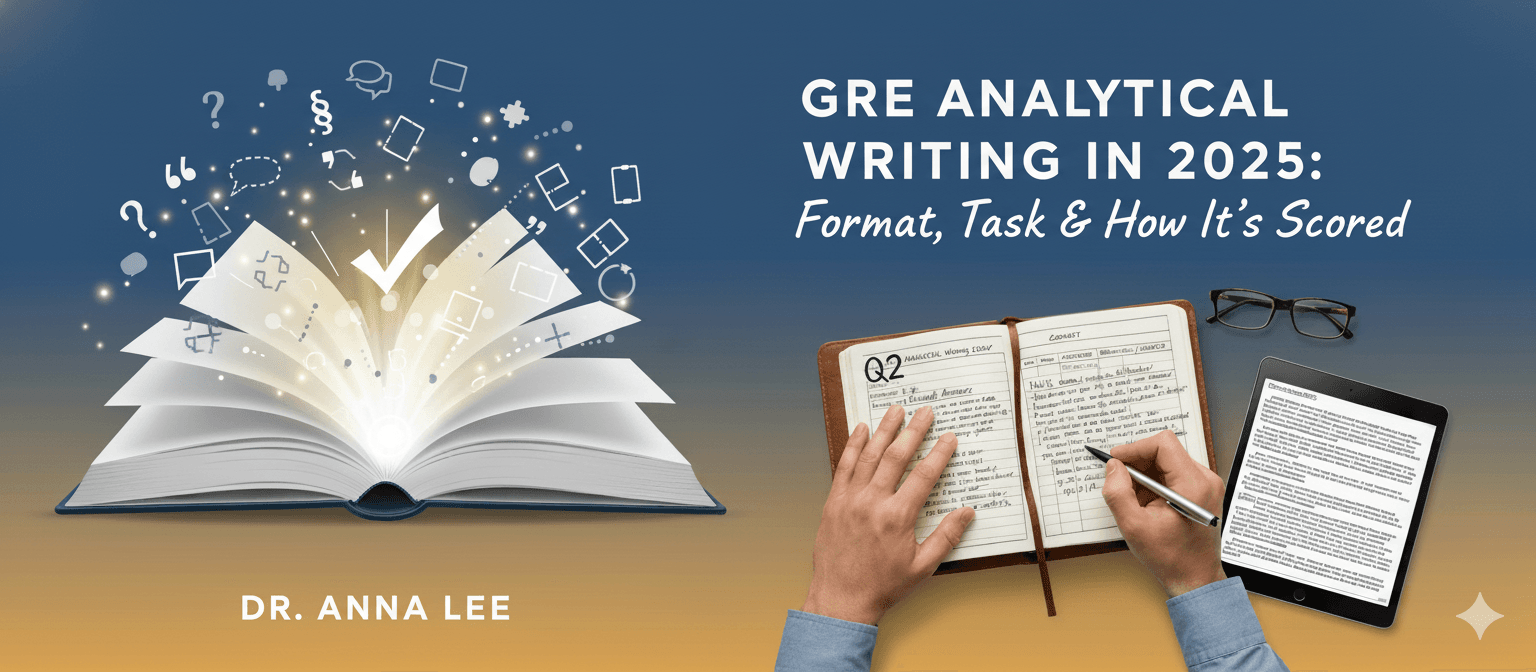
The Analytical Writing Assessment (AWA) is often the most underestimated section of the GRE. While most aspirants focus heavily on Quant and Verbal, the AWA quietly sits at the beginning of your test—setting the tone for everything that follows.
But here's the thing: a strong AWA score doesn't just reflect your writing skills. It shows graduate schools that you can analyse arguments, structure your thoughts, and communicate effectively under pressure. And in 2025, with admissions becoming increasingly competitive, every section counts.
So, what does the AWA actually test? How is it structured? And more importantly, how is it scored?
Let's break it down.
What Is the GRE Analytical Writing Section?
The AWA section measures your ability to articulate complex ideas clearly and support them with relevant reasoning. Unlike the multiple-choice sections, this is where you write—and your writing is evaluated by both a human rater and an AI scoring system.
You'll encounter one essay task in 2025: the Analyze an Argument task.
Yes, just one. The "Analyze an Issue" task was discontinued in September 2023. This change was part of ETS's effort to shorten the GRE while maintaining its effectiveness as a predictor of graduate school success.
The Analyze an Argument Task: What You Need to Do
In this task, you're presented with a short argument—usually a paragraph or two. Your job isn't to agree or disagree with it. Instead, you need to evaluate the logical soundness of the argument.
Think of yourself as a critical reader, not a debater.
Here's What the Task Looks Like:
You'll see an argument that makes a claim based on certain evidence or assumptions. Your task is to:
- Identify the logical flaws or questionable assumptions in the argument
- Explain how these weaknesses undermine the conclusion
- Discuss what additional evidence would strengthen or weaken the argument
You'll have 30 minutes to plan and write your response.
Example Prompt:
"The following appeared in a memo from the director of a large group of hospitals: 'In a laboratory study of liquid antibacterial hand soaps, a concentrated solution of UltraClean produced a 40 percent greater reduction in the bacteria population than did the liquid hand soaps currently used in our hospitals. During a subsequent test of UltraClean at our hospital in Workby, that hospital reported significantly fewer cases of patient infection than did any of the other hospitals in our group. Therefore, to prevent serious patient infections, we should supply UltraClean at all hand-washing stations throughout our hospital system.'"
Your task: critique the reasoning. What assumptions does the argument rely on? What evidence is missing? How could the argument be made stronger?
What Are Evaluators Looking For?
Your essay is scored on a scale of 0 to 6, in half-point increments. Both a trained human rater and an AI system (called e-rater) evaluate your response. If their scores differ by more than one point, a second human rater steps in.
Here's what they assess:
1. Critical Thinking
Can you identify the logical gaps in the argument? Do you explain why these gaps matter?
Strong essays don't just point out flaws—they explain the implications of those flaws clearly.
2. Organization and Structure
Is your essay easy to follow? Do you have a clear introduction, body paragraphs, and conclusion?
Each paragraph should focus on one main idea. Transitions between paragraphs should feel natural, guiding the reader through your analysis.
3. Language Use and Clarity
Are your sentences clear and varied? Do you use vocabulary appropriately?
You don't need to sound overly formal or use fancy words. What matters is clarity and precision. Avoid repetitive sentence structures and overly complex language that obscures your meaning.
4. Support and Development
Do you support your points with reasoning and examples? Or are your claims vague and unsupported?
For instance, instead of saying "the argument is weak," explain why it's weak and how it could be improved with specific evidence.
Understanding the Scoring Scale
Here's a simplified breakdown of what each score range typically represents:
6.0 (Outstanding): Insightful analysis, well-organized, articulate, and nearly flawless in language use.
5.0 (Strong): Clear and thoughtful analysis, well-structured, with minor errors that don't interfere with meaning.
4.0 (Adequate): Competent analysis with some organization and clarity, but may lack depth or have noticeable language issues.
3.0 (Limited): Flawed analysis, weak organization, or frequent language errors that affect clarity.
2.0 (Seriously Flawed): Unclear or illogical analysis, poor organization, and significant language problems.
1.0 (Fundamentally Deficient): Little to no analysis, severe language issues, or off-topic response.
0: Off-topic, copied text, or written in a foreign language.
Most competitive programs look for scores in the 4.0–5.0 range, though top-tier schools may expect higher.
Common Mistakes to Avoid
Even well-prepared aspirants stumble in the AWA section. Here are some pitfalls to watch out for:
Taking a Stance on the Argument
Remember, you're not writing an opinion essay. Don't argue for or against the conclusion. Your job is to evaluate the logic behind it.
Listing Flaws Without Explanation
Simply pointing out that "the argument lacks evidence" isn't enough. Explain what evidence is missing and why it matters.
Ignoring Structure
A wall of text is hard to follow. Use paragraphs, transitions, and a clear introduction and conclusion.
Overthinking Vocabulary
Using "utilize" instead of "use" won't boost your score. Focus on clarity and coherence, not showing off your thesaurus.
Skipping the Planning Phase
Even 3–4 minutes of outlining can save you from a disorganized essay. Jot down the main flaws you'll discuss and the order you'll address them.
How to Approach the Essay Strategically
Here's a simple framework that works:
Step 1: Read the Argument Carefully (2–3 minutes)
Identify the conclusion, the evidence provided, and the assumptions the argument relies on.
Step 2: Brainstorm Flaws (2–3 minutes)
Ask yourself:
- What assumptions does this argument make?
- What evidence is missing?
- Are there alternative explanations for the evidence provided?
- What would strengthen or weaken this argument?
Step 3: Outline Your Essay (2 minutes)
Plan a simple structure:
- Introduction: Briefly restate the argument and your overall assessment
- Body Paragraph 1: First major flaw
- Body Paragraph 2: Second major flaw
- Body Paragraph 3 (optional): Additional flaw or counterpoint
- Conclusion: Summarize and suggest how the argument could be improved
Step 4: Write (20 minutes)
Stick to your outline. Write clearly and concisely. Aim for 400–600 words—enough to develop your ideas without unnecessary padding.
Step 5: Review (2–3 minutes)
Check for glaring errors, awkward phrasing, or missing words. You don't need perfection, but clarity matters.
Does the AWA Section Really Matter?
This is a question many aspirants ask. The short answer: it depends on the program.
Most graduate programs prioritise Quant and Verbal scores. However, the AWA score is often used as a secondary indicator, especially in programs that involve research, writing, or communication-heavy coursework.
A very low AWA score (below 3.0) can raise red flags, particularly if your application involves writing samples or if English isn't your first language. On the other hand, a strong score won't compensate for weak Quant or Verbal performance—but it can reinforce your overall application.
Some aspirants find it easier to stay consistent with structured practice tools like PrepAiro, which help track progress and identify weak areas across all GRE sections, including AWA.
Final Thoughts
The GRE Analytical Writing section may feel daunting, but it's also one of the most predictable parts of the exam. The task is always the same: evaluate an argument's logic. The scoring criteria are transparent. And with the right approach, you can write a clear, well-structured essay even under time pressure.
You don't need to be a brilliant writer to score well. You just need to think critically, organise your thoughts, and communicate them clearly.
So take the AWA seriously. Practice with sample prompts. Time yourself. And remember: this essay is your chance to show graduate schools that you can think, analyse, and write—all skills that matter far beyond test day.
Frequently Asked Questions
1. How long should my GRE Analytical Writing essay be?
There's no official word count requirement, but most high-scoring essays are between 400 and 600 words. Focus on quality over quantity—clear reasoning and strong organisation matter more than length.
2. Is the GRE AWA scored by a human or a computer?
Both. Your essay is evaluated by one trained human rater and an AI system called e-rater. If their scores differ by more than one point, a second human rater reviews your essay.
3. Can I use personal examples in the Analyze an Argument task?
Not really. The Analyze an Argument task asks you to evaluate the logic of a given argument, not share personal experiences. Stick to logical analysis and avoid bringing in unrelated anecdotes.
4. What happens if I don't finish my essay on time?
An incomplete essay will likely receive a lower score, as evaluators look for a clear conclusion. Practice timing yourself so you can finish a full draft within 30 minutes.
5. Do spelling and grammar mistakes affect my AWA score?
Minor errors won't significantly hurt your score if your ideas are clear and well-organised. However, frequent or serious language errors can lower your score, especially if they interfere with understanding.
6. Can I skip the AWA section?
Technically, you can skip it, but you'll receive a score of 0, which most programs will see. Even a modest score is better than none, so it's worth attempting the essay.
Table of content
Share
Written By

Suggested Posts

The Accuracy Trap: Why the Shorter GRE Punishes Old Study Habits — and How to Rewire Your Prep Strategy
Mar 31, 2026

GRE Score Validity & Sending Scores 2026: When Scores Expire, ScoreSelect Strategy & Smart Reporting
Mar 18, 2026

GRE for Indian Students 2026: Complete Guide to Eligibility, Fees, Preparation Tips & Common Mistakes
Mar 18, 2026

Designing Your GRE Study Plan: From Target Scores to Tracking Progress
Mar 13, 2026

GRE Syllabus 2026: All Topics & Question Types Demystified
Mar 13, 2026

GRE Costs & Policies: Exam Fees, Retakes & Score Reporting Explained
Mar 13, 2026
GRE Quantitative Reasoning 2026: The Complete Strategy Guide
Mar 13, 2026

GRE Analytical Writing 2026: Complete Guide, Templates & Scoring
Mar 13, 2026

GRE Scores for Top Universities 2026
Mar 13, 2026

GRE At Home vs Test Center 2026: Complete Comparison + Which One Is Right for You (India Guide)
Mar 13, 2026