Economic Growth Journey of India pt.1
6 min read
Nov 20, 2025
Introduction
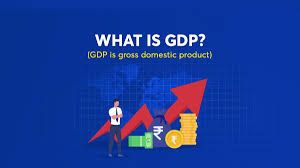
GDP (Gross Domestic Product) is the primary measure of a country's economic performance. GDP serves as an aggregate measure of national income, capturing the economic output — from consumer goods to services, agricultural products to technology. Policymakers, investors, and economists rely on GDP to assess economic health and make informed decisions.
The Concept of GDP
What is GDP?
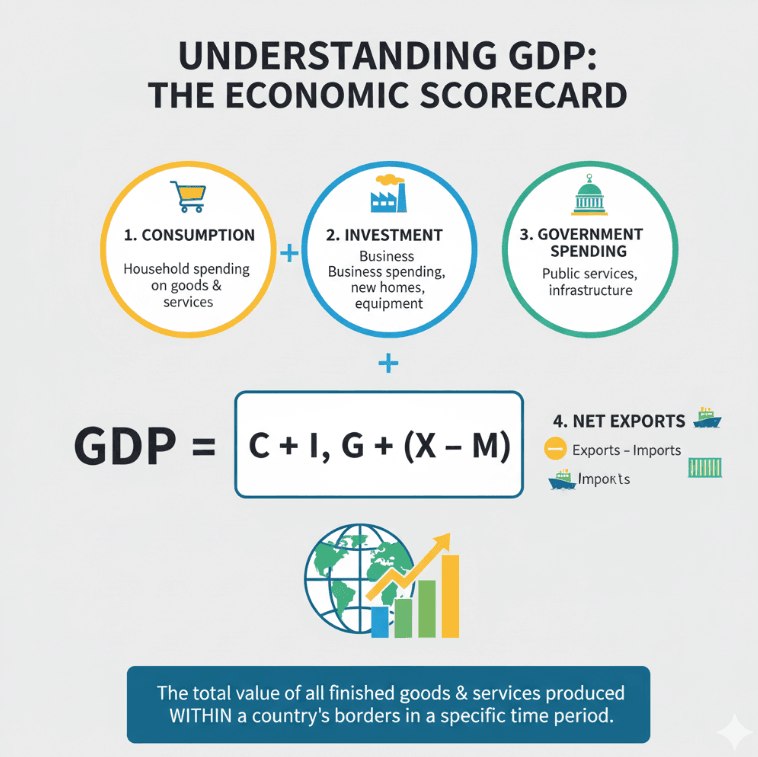
GDP is the monetary value of all final goods and services produced within a country's domestic territory during a specific time period.
Final goods and services are products sold to end consumers or businesses for final use, not for resale or further production.
For example, a car sold to a consumer is a final good, while steel sold to a car manufacturer is an intermediate good. GDP counts only final goods to avoid double counting—if we counted both the steel and the car, we'd be counting the steel's value twice.
Domestic territory includes not just the political boundaries of a country, but also:
- Territorial waters and airspace
- Ships and aircraft operated by residents between countries
- Fishing vessels and oil rigs operated by residents in international waters
- Embassies, consulates, and military establishments abroad
However, it excludes foreign embassies and consulates located within the country's borders.
GDP Includes:
- Consumer spending on goods and services
- Business investments in equipment and infrastructure
- Government expenditure on public services
- Net exports (exports minus imports)
GDP Excludes:
- Intermediate goods (goods used in production of final goods - excluded to avoid double counting)
- Secondhand goods (already counted when first sold)
- Non-market transactions (household work, volunteer services)
- Transfer payments (social security, unemployment benefits - these are redistributions, not new production)
The GDP Formula - GDP = C + I + G + NX
Where:
- C = Consumption (Household spending)
- I = Investment (Business capital expenditure)
- G = Government Spending (Public sector expenditure)
- NX = Net Exports (Exports minus Imports)
Factors That Impact GDP
1. Consumption (C)
Consumption typically represents 55-70% of GDP, making it the largest economic driver. It includes all household spending on goods and services.
Key Drivers:
- Disposable income and wage growth
- Consumer confidence and employment outlook
- Interest rates (lower rates boost spending)
- Wealth effect (rising asset prices)
- Demographics and population trends
Categories: Durable goods (cars, appliances), non-durable goods (food, clothing), and services (healthcare, education, entertainment).
2. Investment (I)
Investment represents spending on capital goods for future production, including business equipment, technology, infrastructure, and residential construction.
Capital goods are durable assets (such as machinery, equipment, buildings, and tools) used in the production of other goods and services rather than for direct consumption
Key Influencers:
- Interest rates (lower rates reduce borrowing costs)
- Business confidence and expected returns
- Technological innovation
- Capacity utilization rates
- Regulatory environment
Investment drives both current GDP and future productivity growth, making it critical for long-term economic health.
3. Government Spending (G)
Government spending includes all public consumption and investment expenditure (excluding transfer payments).
Components: Defense, infrastructure, education, healthcare, public administration, and research & development.
Impact: Government spending directly adds to GDP and creates multiplier effects through job creation. However, excessive borrowing can crowd out private investment by raising interest rates. Governments often use fiscal policy counter-cyclically, increasing spending during recessions.
4. Net Exports (NX)
Net exports = Exports - Imports. Positive net exports (trade surplus) add to GDP; negative net exports (trade deficit) subtract from it.
Key Factors:
- Exchange rates (weaker currency boosts exports)
- Global economic growth
- Trade policies and agreements
- International competitiveness
- Domestic consumption patterns
5. Other Critical Factors
Productivity & Technology: Innovation increases output per worker, driving growth without proportional input increases.
Labor Force: Workforce size, skills, education, and participation rates directly impact productive capacity.
Natural Resources: Endowments of oil, minerals, and agricultural land provide competitive advantages.
Governance: Political stability, rule of law, and strong institutions create growth-conducive environments.
Financial Systems: Robust banking and capital markets facilitate efficient capital allocation.
Monetary Policy: Central bank policies on interest rates and money supply influence investment and consumption.
External Shocks: Global crises, pandemics, wars, and commodity price changes can significantly impact GDP.
Conclusion
GDP remains the most comprehensive measure of economic performance, capturing the complex interplay of consumption, investment, government spending, and trade that drives economic activity.GDP is the most comprehensive measure of economic performance, reflecting the complex interplay of consumption, investment, government spending, and trade that drives economic activity.
For more in-depth explainers on key economic indicators, follow us!
Table of content
Share
Written By

Suggested Posts

The Accuracy Trap: Why the Shorter GRE Punishes Old Study Habits — and How to Rewire Your Prep Strategy
Mar 31, 2026

GRE Score Validity & Sending Scores 2026: When Scores Expire, ScoreSelect Strategy & Smart Reporting
Mar 18, 2026

GRE for Indian Students 2026: Complete Guide to Eligibility, Fees, Preparation Tips & Common Mistakes
Mar 18, 2026

Designing Your GRE Study Plan: From Target Scores to Tracking Progress
Mar 13, 2026

GRE Syllabus 2026: All Topics & Question Types Demystified
Mar 13, 2026

GRE Costs & Policies: Exam Fees, Retakes & Score Reporting Explained
Mar 13, 2026

GRE Quantitative Reasoning 2026: The Complete Strategy Guide
Mar 13, 2026

GRE Analytical Writing 2026: Complete Guide, Templates & Scoring
Mar 13, 2026

GRE Scores for Top Universities 2026
Mar 13, 2026

GRE At Home vs Test Center 2026: Complete Comparison + Which One Is Right for You (India Guide)
Mar 13, 2026