Data Interpretation & Probability on GRE: 2025 Guide
5 min read
Dec 22, 2025
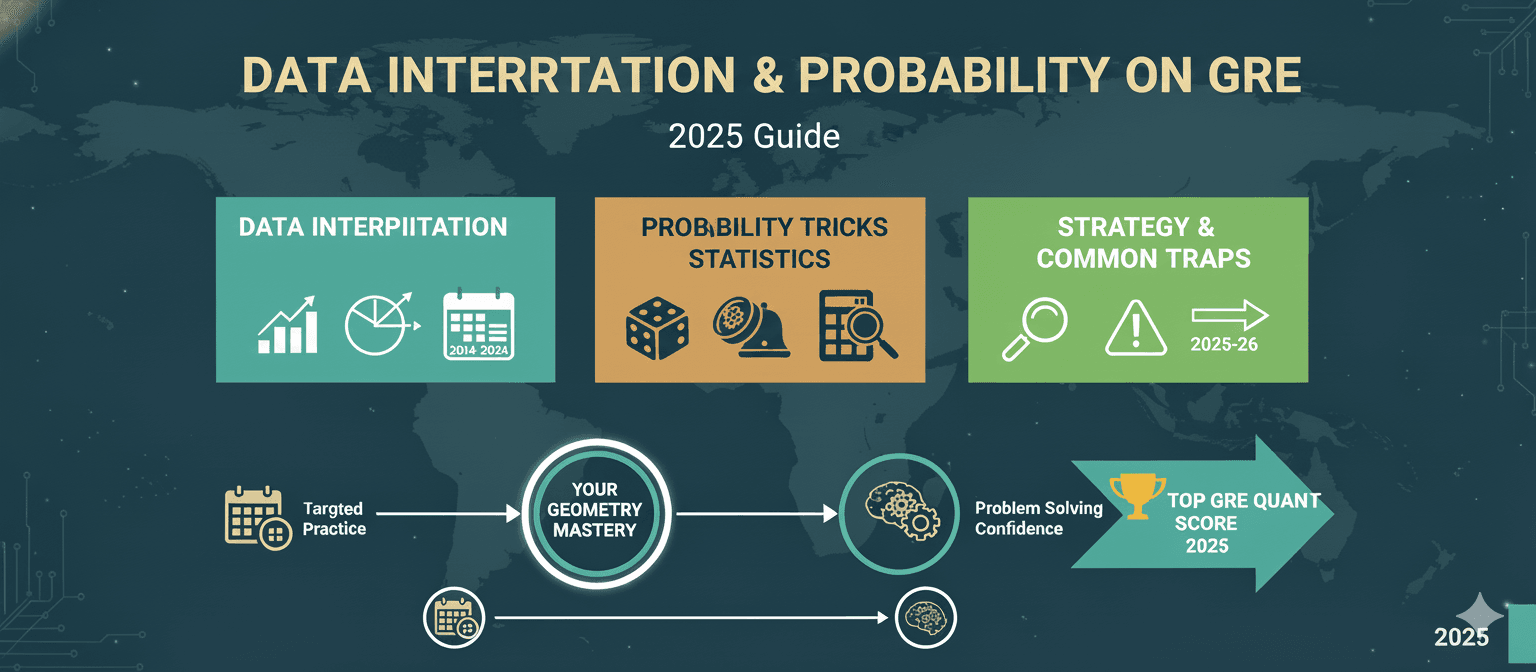
Why Data Interpretation and Probability Matter on the GRE
If you've ever stared at a clustered bar graph or a probability word problem and felt your confidence slip, you're not alone. Data interpretation (DI) and probability questions form a significant portion of the GRE Quantitative Reasoning section, and they're designed to test not just your math skills but your ability to analyse information quickly and accurately.
The good news? These aren't inherently difficult topics. With the right approach and consistent practice, you can turn these question types into scoring opportunities.
Understanding Data Interpretation on the GRE
Data interpretation questions present information through charts, graphs, tables, or data plots. Your job is to extract relevant data, perform calculations, and draw conclusions—all within a tight time frame.
Common Graph Types You'll Encounter
Bar graphs compare quantities across categories. Watch for clustered or stacked bars that require careful reading.
Line graphs show trends over time. Focus on slopes, intersections, and relative changes rather than absolute values.
Pie charts represent parts of a whole. Calculate percentages and proportions, and be ready to work with both given and missing data.
Scatter plots display relationships between two variables. Look for patterns, outliers, and correlations.
Tables present raw data in rows and columns. These often require multiple calculations or comparisons across categories.
Tactics for Tackling DI Questions
Start by reading the question before diving into the graph. This tells you exactly what to look for and saves precious seconds.
Identify the units and scales. A common trap is misreading axis labels or mixing up thousands with lakhs.
Estimate when possible. The GRE rarely requires exact calculations for DI questions. If the answer choices are spread apart, a quick approximation works perfectly.
Work systematically through multi-part questions. Some DI sets include three questions based on the same data. Answer them in order and use information from earlier questions to save time on later ones.
Statistics Essentials for the GRE
Statistics questions on the GRE focus on understanding and interpreting data rather than complex formulas. Here's what you need to know.
Mean, Median, and Mode
Mean is the average—add all values and divide by the count. Be cautious when dealing with weighted averages or when new data points are added.
Median is the middle value in an ordered set. For even-numbered sets, it's the average of the two middle values. The GRE loves testing scenarios where the mean and median differ significantly.
Mode is the most frequently occurring value. It's less commonly tested but appears in data distribution questions.
Range and Standard Deviation
Range measures spread by subtracting the smallest value from the largest. It's straightforward but watch for questions that ask about possible ranges when some data is unknown.
Standard deviation indicates how spread out values are from the mean. You don't need to calculate it manually—focus on understanding that larger standard deviations mean more variability.
Quartiles and Percentiles
Quartiles divide data into four equal parts. The first quartile (Q1) marks the 25th percentile, the median is Q2 (50th percentile), and Q3 represents the 75th percentile.
Percentiles tell you the percentage of data below a certain value. If you scored in the 80th percentile, you performed better than 80% of test-takers.
Probability Fundamentals
Probability questions measure your ability to calculate the likelihood of events occurring. The GRE tests basic probability concepts, not advanced combinatorics or complex probability theory.
Core Probability Rules
Basic probability formula: Probability = (Number of favourable outcomes) / (Total number of possible outcomes)
Values range from 0 (impossible) to 1 (certain). The GRE often expresses probability as fractions or decimals rather than percentages.
Independent vs Dependent Events
Independent events don't affect each other. When flipping a coin twice, the first flip doesn't influence the second. Multiply probabilities: P(A and B) = P(A) × P(B)
Dependent events influence each other. Drawing cards without replacement changes the probability for subsequent draws. Adjust denominators after each event.
Complementary Probability
Sometimes it's easier to calculate what you don't want and subtract from 1. For instance, finding the probability of getting at least one head in three coin flips is simpler when you calculate the probability of getting zero heads and subtracting from 1.
P(at least one) = 1 - P(none)
Common Probability Scenarios
"And" scenarios (both events occur) typically require multiplication.
"Or" scenarios (at least one event occurs) involve addition, but subtract any overlap to avoid double-counting.
Conditional probability asks about the likelihood of an event given that another has occurred. Focus on the reduced sample space.
Building Your Practice Strategy
Knowing concepts is one thing. Applying them under timed conditions is another. Here's how to build real competence.
Start with untimed practice to cement concepts. Once you're comfortable, gradually introduce time pressure. Track which question types consistently trip you up and dedicate focused practice sessions to those areas.
Review every mistake thoroughly. Understanding why you got something wrong matters more than getting something right by chance. Some aspirants find it easier to stay consistent using structured practice tools like PrepAiro, which offer targeted question sets organised by topic.
Mix question types in your practice sessions. Don't just do 20 probability questions in a row—alternate between DI, probability, and other Quant topics to simulate actual test conditions.
Common Pitfalls to Avoid
Rushing through graphs without checking labels and scales leads to careless errors. Take three seconds to verify what you're reading.
Overcomplicating probability questions happens often. Most GRE probability problems require basic multiplication or addition—not advanced formulas.
Forgetting that percentages in DI questions might not add to 100% when the question involves multiple categories or overlapping data.
Mixing up "at least" with "exactly" in probability questions changes the entire calculation approach.
Moving Forward with Confidence
Data interpretation and probability aren't about memorising endless formulas. They're about developing a systematic approach to analysing information and making calculations efficiently. Start with the fundamentals, practice consistently across different question formats, and focus on understanding your mistakes rather than just accumulating correct answers.
The GRE Quant section rewards clarity of thought and methodical problem-solving. With these tools and tactics, you're building exactly those skills—one practice question at a time.
FAQ Section
Q1: How many data interpretation questions appear on the GRE?
The GRE doesn't specify exact numbers, but data interpretation typically accounts for 3-4 questions per Quantitative section. These often appear as sets where 2-3 questions relate to the same graph or table.
Q2: Do I need to memorise probability formulas for the GRE?
No extensive memorisation is required. Focus on understanding basic probability (favourable outcomes divided by total outcomes), independent versus dependent events, and complementary probability. The GRE tests application more than formula recall.
Q3: What's the fastest way to improve at reading graphs and charts?
Practice with varied graph types under timed conditions. Start by reading the question first to know what you're looking for, then scan the graph systematically. Newspapers and business reports are excellent sources for additional real-world graph practice.
Q4: Are statistics questions calculation-heavy on the GRE?
Not usually. GRE statistics questions focus more on conceptual understanding—knowing when median differs from mean, understanding what standard deviation represents, or interpreting data distributions. Heavy calculations are rare and estimation often suffices.
Q5: How do I avoid silly mistakes in probability questions?
Write out your work systematically. List total outcomes, identify favourable ones, and double-check whether events are independent or dependent. For complex scenarios, draw tree diagrams or simple charts to visualise the possibilities.
Q6: Should I use the on-screen calculator for DI questions?
Use it selectively. For simple additions or subtractions, mental math is faster. For percentages of large numbers or multi-step calculations, the calculator saves time and reduces errors. Practice with the ETS calculator during preparation to build familiarity.
Written By

Suggested Posts

The Accuracy Trap: Why the Shorter GRE Punishes Old Study Habits — and How to Rewire Your Prep Strategy
Mar 31, 2026

GRE Score Validity & Sending Scores 2026: When Scores Expire, ScoreSelect Strategy & Smart Reporting
Mar 18, 2026

GRE for Indian Students 2026: Complete Guide to Eligibility, Fees, Preparation Tips & Common Mistakes
Mar 18, 2026

Designing Your GRE Study Plan: From Target Scores to Tracking Progress
Mar 13, 2026

GRE Syllabus 2026: All Topics & Question Types Demystified
Mar 13, 2026

GRE Costs & Policies: Exam Fees, Retakes & Score Reporting Explained
Mar 13, 2026

GRE Quantitative Reasoning 2026: The Complete Strategy Guide
Mar 13, 2026

GRE Analytical Writing 2026: Complete Guide, Templates & Scoring
Mar 13, 2026

GRE Scores for Top Universities 2026
Mar 13, 2026

GRE At Home vs Test Center 2026: Complete Comparison + Which One Is Right for You (India Guide)
Mar 13, 2026