Adaptive GRE Study Planning: Let Your Practice Tests Guide You
5 min read
Dec 15, 2025
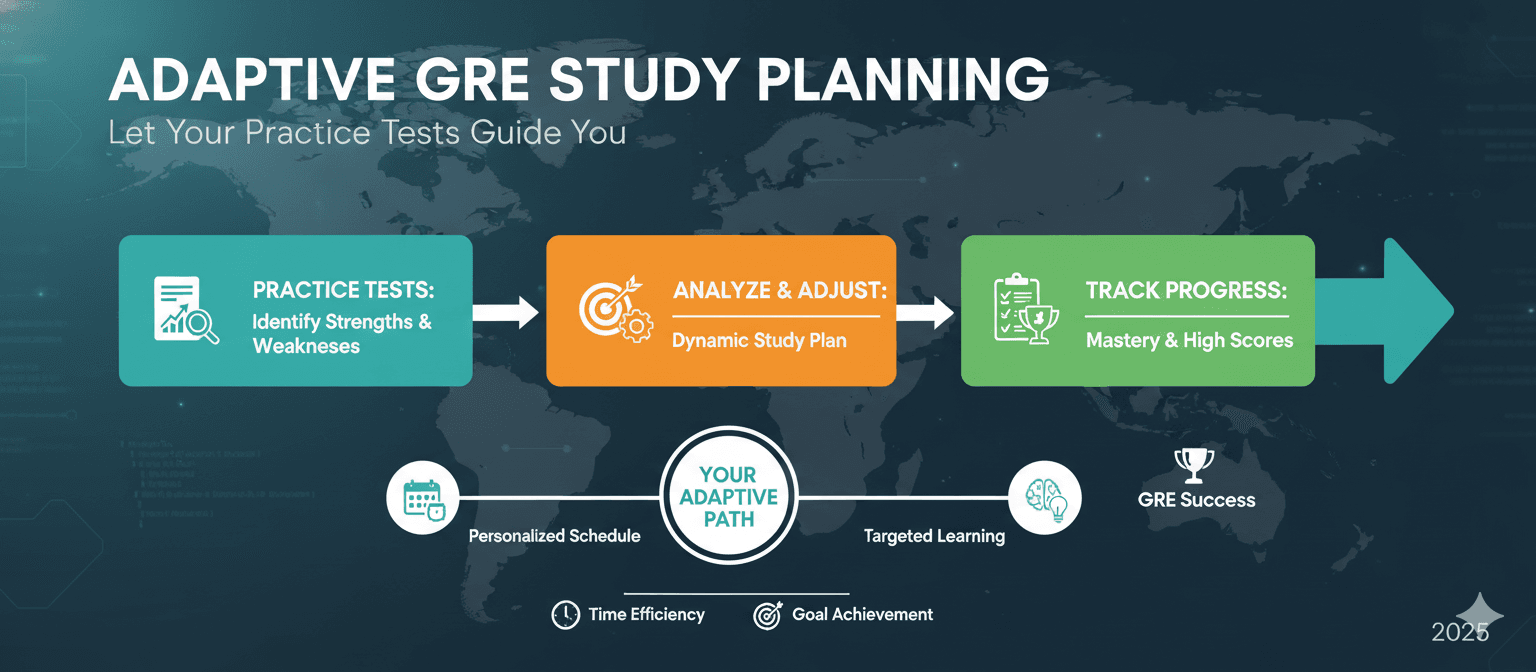
Most GRE prep advice follows a predictable script: study vocabulary, practice math formulas, take practice tests, repeat. But here's what that approach misses—your practice tests aren't just measuring progress. They're generating a diagnostic blueprint that, when properly analyzed, can transform scattered studying into surgical precision.
The difference between students who plateau at 310 and those who reach 330+ often comes down to one skill: learning to let their mistakes teach them where to focus next.
Why Traditional Study Plans Fall Short
A rigid study plan treats every topic with equal weight. Spend two weeks on geometry, two weeks on reading comprehension, two weeks on vocabulary—regardless of whether geometry is your strength or your weakness.
Research in adaptive learning systems reveals why this approach underperforms. A comprehensive review of personalized learning studies found that adaptive approaches—those that adjust based on individual performance data—increased academic performance in 59% of studies compared to traditional methods. The key difference wasn't study time; it was study allocation.
Your brain already knows which GRE concepts are solid and which are shaky. Your practice tests are simply making that knowledge visible. The question is whether you're paying attention.
The Science of Learning from Errors
Here's a counterintuitive finding from cognitive psychology: analyzing your mistakes produces better long-term retention than reviewing content you already understand.
Researchers Wong and Lim identified what they call the "derring effect"—deliberately engaging with errors and their corrections creates stronger memory traces than passive review. Their experiments showed that students who systematically analyzed and corrected their mistakes outperformed those who simply restudied material, particularly on delayed tests measuring long-term retention.
Why does this work? When you encounter an error and trace its root cause, you're forcing your brain to do three things simultaneously: activate prior knowledge, identify the specific gap that caused the mistake, and create a distinctive memory around the correction. This triple processing creates what cognitive scientists call "desirable difficulty"—productive struggle that feels harder in the moment but produces durable learning.
For GRE prep, this means your error log isn't just a record of mistakes. It's the raw material for the most efficient learning possible.
Building Your Diagnostic Feedback Loop
Effective adaptive study planning follows a simple cycle: test, analyze, target, repeat. Here's how to implement each phase.
Phase 1: Strategic Diagnostic Testing
Before diving into content review, establish your baseline with a full-length practice test under realistic conditions. The GRE's section-adaptive format means your performance on the first Quant or Verbal section determines the difficulty of the second—so a diagnostic test reveals not just what you know, but how you perform under authentic pressure.
ETS offers free PowerPrep practice tests that mirror the actual exam. Take one without studying first. Your goal isn't a high score—it's accurate data about where you currently stand.
Phase 2: Error Analysis That Actually Works
Most students check their answers, feel frustrated about mistakes, and move on. This is precisely where the learning opportunity gets wasted.
For every incorrect answer, document three things:
First, identify the error type. Did you misunderstand the concept entirely? Make a careless calculation error? Run out of time? Misread the question? Each error type requires a different remedy. Concept gaps need content review. Careless errors need process changes. Time pressure needs pacing strategy.
Second, trace the root cause. For a geometry problem you missed, was it because you forgot the formula for the area of a sector, or because you knew the formula but applied it incorrectly? The first is a knowledge gap; the second is an application problem. Different problems, different solutions.
Third, record the topic and subtopic. "Missed a math question" is useless. "Missed a number properties question involving prime factorization" is actionable.
Phase 3: Pattern Recognition
After analyzing 30-50 questions, patterns emerge. Maybe you consistently miss the third sentence equivalence question in each verbal section—suggesting fatigue or pacing issues with that question type. Perhaps geometry questions involving coordinate planes account for 40% of your quant errors.
These patterns are gold. They tell you exactly where focused study will yield the highest return.
Phase 4: Targeted Intervention
Now your study plan adapts to your data. Instead of generic math review, you're drilling coordinate geometry specifically. Instead of memorizing 500 vocabulary words, you're focusing on the word types that appear in the questions you miss most—perhaps words with subtle negative connotations or technical terms used in non-technical contexts.
This is where the efficiency gains compound. Time spent on already-mastered concepts is time wasted. Time spent on systematically identified weaknesses is time multiplied.
Implementing Adaptive Cycles Throughout Prep
The diagnostic feedback loop isn't a one-time exercise—it's an ongoing process that should structure your entire preparation timeline.
Early Prep (6-8 weeks out): Focus on broad diagnostics. Identify major topic gaps and address fundamental content weaknesses.
Mid Prep (3-5 weeks out): Shift to question-type analysis. Which specific question formats consistently trip you up? Text completion versus sentence equivalence? Quantitative comparison versus problem-solving?
Final Prep (1-2 weeks out): Concentrate on timing and endurance patterns. Where in the test does your accuracy drop? Are you losing points to the section-adaptive second sections because early fatigue compounds?
Each phase generates new data that refines the next phase's focus.
The Metacognitive Advantage
Students who use error analysis systematically develop something researchers call metacognitive awareness—the ability to accurately assess their own learning. Studies show that learners often experience "metacognitive illusions," believing that easier study methods (like rereading) are more effective than harder methods (like active error analysis) that actually produce better outcomes.
By forcing yourself to confront mistakes analytically rather than emotionally, you calibrate your self-assessment. You stop overestimating strengths and stop avoiding weaknesses. This metacognitive accuracy might be the most valuable skill you develop—useful far beyond test day.
Your Next Step
Pull up your most recent practice test. Pick three questions you got wrong. For each, answer: What type of error was it? What specific concept or skill failed? What would you need to study to prevent this exact mistake next time?
That fifteen-minute exercise will teach you more about your GRE readiness than hours of unfocused review.
The GRE rewards efficiency over effort. Your practice tests are already generating the data you need. The only question is whether you'll use it.
FAQ Section (Featured Snippet Optimized)
How often should I take GRE practice tests?
Take a full-length practice test every 7-10 days during active prep. This provides enough data for meaningful pattern analysis while allowing time for targeted study between tests.
What should I track in a GRE error log?
Track the question number, topic/subtopic, error type (concept gap, careless mistake, time pressure, misread question), root cause analysis, and the specific skill needed to correct it.
How do I know if my GRE study plan is working?
Compare error patterns across practice tests. Effective study plans show decreasing errors in targeted areas, even if overall scores fluctuate initially due to addressing harder content.
Should I review questions I got right?
Yes, selectively. Review correct answers where you guessed or felt uncertain—these represent hidden weaknesses that haven't yet produced visible errors.
Written By

Suggested Posts

The Accuracy Trap: Why the Shorter GRE Punishes Old Study Habits — and How to Rewire Your Prep Strategy
Mar 31, 2026

GRE Score Validity & Sending Scores 2026: When Scores Expire, ScoreSelect Strategy & Smart Reporting
Mar 18, 2026

GRE for Indian Students 2026: Complete Guide to Eligibility, Fees, Preparation Tips & Common Mistakes
Mar 18, 2026

Designing Your GRE Study Plan: From Target Scores to Tracking Progress
Mar 13, 2026

GRE Syllabus 2026: All Topics & Question Types Demystified
Mar 13, 2026

GRE Costs & Policies: Exam Fees, Retakes & Score Reporting Explained
Mar 13, 2026

GRE Quantitative Reasoning 2026: The Complete Strategy Guide
Mar 13, 2026

GRE Analytical Writing 2026: Complete Guide, Templates & Scoring
Mar 13, 2026

GRE Scores for Top Universities 2026
Mar 13, 2026

GRE At Home vs Test Center 2026: Complete Comparison + Which One Is Right for You (India Guide)
Mar 13, 2026