3-Month GRE Study Plan for Working Professionals | Realistic Week-by-Week Guide
5 min read
Dec 11, 2025
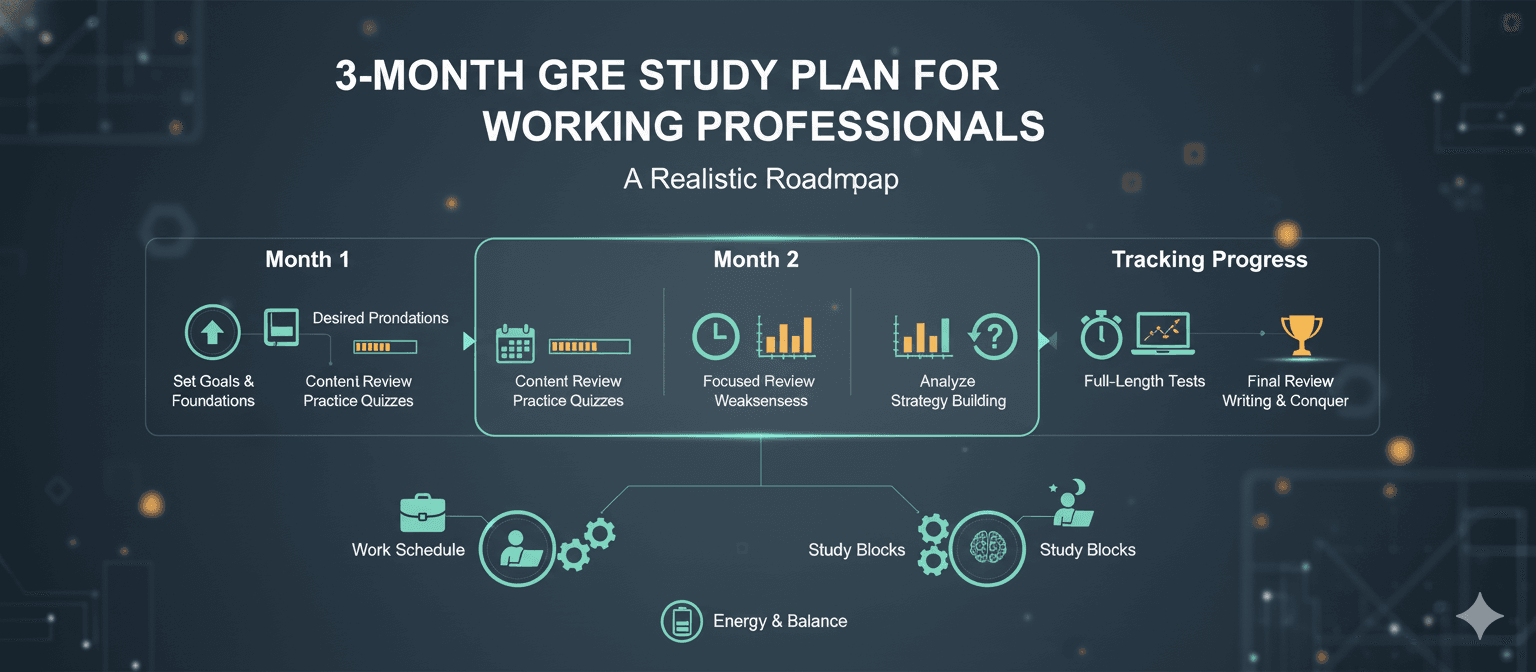
Nearly half of all GRE test-takers worldwide are working professionals balancing full-time careers with graduate school aspirations. If that's you, you already know the challenge isn't understanding the material—it's finding the time and energy after an 8-hour workday.
Here's what most study guides won't tell you: your brain processes information differently after cognitive work. Research on learning science shows that spaced repetition—spreading study sessions across days rather than cramming—produces significantly stronger long-term memory compared to intensive single sessions. This makes shorter, consistent study blocks more effective than marathon weekend sessions.
This 12-week plan works with your professional schedule, not against it.
The Science Behind This Plan
Before diving into the schedule, understanding why this approach works will help you stay committed when motivation dips.
Your brain has two types of memory strength: storage strength (how deeply information is encoded) and retrieval strength (how easily you can access it). Counterintuitively, allowing some forgetting between study sessions actually improves learning. When you struggle slightly to recall information, you strengthen both storage and retrieval pathways—a phenomenon cognitive scientists call "desirable difficulty."
This is why studying 7 hours every Saturday produces weaker retention than studying 1 hour daily for a week. The plan below leverages this principle systematically.
Weekly Time Commitment
This plan requires approximately 8-10 hours per week, structured as:
- Weekdays: 1-1.5 hours daily (5-7.5 hours total)
- Weekend: 2-3 hours on one day (for practice tests and review)
Most working professionals find early morning (before work) or late evening (after dinner) sessions most sustainable. Choose one window and protect it fiercely.
Phase 1: Foundation Building (Weeks 1-4)
The first month establishes your baseline, identifies weaknesses, and builds fundamental skills.
Week 1: Assessment and Setup
Start with a diagnostic test using ETS PowerPrep (free at ets.org). Take it under realistic conditions—this score becomes your benchmark. Research your target programs to establish your goal score, then calculate the gap.
Daily tasks this week: Begin vocabulary acquisition with 10-15 new words daily using a spaced repetition app. Create your math formula reference sheet as you encounter concepts. These daily habits continue throughout the plan.
Week 2: Quantitative Foundations
Focus entirely on arithmetic, number properties, and basic algebra. These topics underpin approximately 60% of Quant questions. Spend 45-60 minutes on concept review and 15-30 minutes on targeted practice problems.
By week's end, you should solve basic problems without hesitation.
Week 3: Verbal Foundations
Shift focus to Reading Comprehension strategies. Learn to identify passage structure, author's tone, and main arguments before tackling questions. Practice active reading techniques on 2-3 passages daily.
Continue vocabulary work—you should have approximately 100-150 words mastered by now.
Week 4: Advanced Quant Topics
Cover geometry, coordinate geometry, and data interpretation. These topics appear less frequently but often carry higher difficulty. Weekend session: Take a 27-question Quant-only practice set under timed conditions.
Review errors meticulously. Create flashcards for any formulas or concepts you missed.
Phase 2: Skill Development (Weeks 5-8)
With foundations established, this phase builds speed and strategy.
Week 5: Text Completion and Sentence Equivalence
These question types depend heavily on vocabulary and logical reasoning. Learn to identify context clues before examining answer choices. Practice the "predict and match" technique—form your own answer before looking at options.
Your vocabulary should now exceed 300 words. Prioritize words that appear repeatedly across practice materials.
Week 6: Advanced Verbal Strategies
Focus on inference questions and critical reasoning. These require reading between the lines and identifying logical relationships. Practice distinguishing between what passages state directly versus what they imply.
Week 7: Quantitative Comparison and Problem-Solving
QC questions are uniquely GRE-specific and require different strategies than standard math problems. Learn when to calculate precisely versus when to estimate. Master the technique of testing boundary cases.
Weekend session: Complete a full-length practice test (ETS PowerPrep 1). Analyze results by question type and topic.
Week 8: Integration Week
Review your error log from the past seven weeks. Which topics consistently cause problems? This week focuses entirely on weakness remediation. Don't move forward until you've addressed recurring errors.
Phase 3: Practice and Refinement (Weeks 9-12)
The final month focuses on test-taking strategies, timing, and building stamina.
Week 9: Timed Practice Intensification
Begin all practice under strict time constraints. For Quant: 47 minutes for 27 questions. For Verbal: 41 minutes for 27 questions. Build comfort with time pressure now, not on test day.
Review the Analytical Writing rubrics and write at least two practice essays this week.
Week 10: Full Test Practice
Take ETS PowerPrep 2 under exact test conditions—no breaks beyond what the actual test allows, realistic testing environment, correct timing. Your score should now approach your target range.
Analyze performance patterns: Do you struggle more in first or second sections? Which question types consume disproportionate time?
Week 11: Strategy Refinement
Based on Week 10 analysis, adjust your approach. If time is an issue, practice strategic skipping—some difficult questions aren't worth the time investment. If accuracy suffers under pressure, build in deliberate pause points.
Take one additional full practice test mid-week.
Week 12: Final Preparation
Light review only in the final days. Trust your preparation. Take your last practice test 5-7 days before the real exam, then shift to maintenance: review vocabulary, revisit error log highlights, and visualize success.
Night before: No studying. Sleep matters more than last-minute cramming.
Adapting for Your Schedule
Heavy Work Periods: During demanding work weeks, maintain vocabulary practice (10 minutes daily) and one 30-minute problem set. Consistency matters more than volume.
Travel Days: Download offline practice materials. Even 20 minutes at the airport maintains momentum.
Low-Energy Evenings: Some days, you're too depleted for new learning. Use these for review rather than new material—flashcards, error log analysis, or watching explanation videos.
What Makes This Plan Different
Most study guides assume unlimited time and energy. This plan acknowledges that after cognitive work, your brain needs efficient rather than exhaustive study. The emphasis on spaced repetition and strategic timing isn't motivational fluff—it's grounded in how memory actually works.
PrepAiro's adaptive practice system applies these same spacing principles automatically, presenting questions at optimal intervals based on your individual retention patterns—something generic study plans can't do.
Your professional experience is actually an advantage here. You understand project management, deadline pressure, and sustained effort toward long-term goals. Apply those same skills to GRE preparation, and 12 weeks is more than sufficient.
FAQ
Can I prepare for the GRE in 3 months while working full-time?
Yes. With 8-10 hours weekly of focused study using spaced repetition principles, three months provides sufficient time for most working professionals to reach their target scores. The key is consistency—shorter daily sessions outperform sporadic marathon study weekends.
What's the best time of day to study for the GRE as a working professional?
Research suggests cognitive performance varies by individual chronotype. However, studying before work ensures sessions happen before daily fatigue accumulates. If mornings aren't feasible, study after a proper break post-work rather than immediately after arriving home.
How many GRE practice tests should I take during a 3-month study plan?
Take 4-5 full-length practice tests total: one diagnostic at the start, one at the end of Phase 2 (Week 7-8), two during Phase 3, and a final test 5-7 days before your exam. Space these strategically rather than taking them back-to-back.
What if I can't study every day as a working professional?
Maintain minimum viable consistency: vocabulary practice (10 minutes) and at least one problem set (20-30 minutes) even on the busiest days. Five short sessions weekly produce better retention than two longer weekend sessions totaling the same hours.
Table of content
Share
Written By

Suggested Posts

The Accuracy Trap: Why the Shorter GRE Punishes Old Study Habits — and How to Rewire Your Prep Strategy
Mar 31, 2026

GRE Score Validity & Sending Scores 2026: When Scores Expire, ScoreSelect Strategy & Smart Reporting
Mar 18, 2026

GRE for Indian Students 2026: Complete Guide to Eligibility, Fees, Preparation Tips & Common Mistakes
Mar 18, 2026

Designing Your GRE Study Plan: From Target Scores to Tracking Progress
Mar 13, 2026

GRE Syllabus 2026: All Topics & Question Types Demystified
Mar 13, 2026

GRE Costs & Policies: Exam Fees, Retakes & Score Reporting Explained
Mar 13, 2026

GRE Quantitative Reasoning 2026: The Complete Strategy Guide
Mar 13, 2026

GRE Analytical Writing 2026: Complete Guide, Templates & Scoring
Mar 13, 2026

GRE Scores for Top Universities 2026
Mar 13, 2026

GRE At Home vs Test Center 2026: Complete Comparison + Which One Is Right for You (India Guide)
Mar 13, 2026